
 By Siti Muinah

By Investigative Staff
Published: Investigative Security Desk
Executive Summary: The Fall of a People-Search Giant
In a stunning legal rebuke that could reshape the landscape of online privacy enforcement, the prominent consumer data broker Radaris.com has lost control of its primary domain. Following years of reported stonewalling, aggressive procedural maneuvers, and a calculated corporate shell game, a New Jersey court ordered the seizure and transfer of radaris.com—along with more than a dozen associated people-search domains—to plaintiffs represented by Atlas Data Privacy Corp.
The seizure stems from violations of New Jersey’s strict Daniel’s Law, a statute explicitly designed to protect state law enforcement personnel, judges, and government officials from targeted harassment by scrubbing their personal information from commercial databases. Faced with mounting court orders, uncooperative defense strategies, and overwhelming documentary evidence, the judiciary bypassed traditional monetary penalties in favor of asset forfeiture, transferring critical infrastructure directly into the hands of privacy advocates.
Yet, as this historic case demonstrates, the broader war over data privacy, corporate transparency, and constitutional protections is far from over. The fallout from the Radaris litigation exposes an intricate web of hidden ownership structures, lucrative cross-industry partnerships, and a fractured American regulatory framework struggling to police the digital age.
Chronology of an Investigation: From Evasion to Enforcement
To understand how a multi-million-dollar data broker empire was brought to its knees, one must trace the timeline of legal confrontations, investigative journalism, and corporate obfuscation that defined the Radaris operation.
The 2017 Precedent
The structural vulnerabilities of Radaris first manifested publicly in 2017, when the company defaulted in a class-action lawsuit (Huebner v. Radaris, LLC) by failing to mount a defense in court. When plaintiffs attempted to collect on a subsequent $7.5 million default judgment, a judge ordered the domain registrar Verisign to transfer radaris.com to the plaintiffs.
Radaris’s legal counsel at the time—Val Gurvits of the Boston Law Group—intervened with an appeal, arguing that the lawsuit had failed to name the true corporate owner of the domain: a Cyprus-registered entity known as Bitseller Expert Limited. The court ultimately halted the transfer, ruling that due process rights had not been fully extended to the actual holding company. Following this narrow escape, the operational control of Radaris shifted to Andtop Company, an entity incorporated in the Marshall Islands in October 2020. The original plaintiffs never refiled, cementing a decade-long perception that the data broker could outmaneuver any legal challenge through jurisdictional attrition.
The Rebirth of Litigation Under Daniel’s Law
The dynamic shifted permanently in February 2024, when Atlas Data Privacy Corp filed a fresh lawsuit against Radaris under New Jersey’s Daniel’s Law. The statute provides for severe fines of $1,000 per violation against commercial data brokers that publish protected personal identifiable information (PII) belonging to judges, law enforcement officers, and public safety officials.
Just weeks after the initial filing, KrebsOnSecurity published a comprehensive deep dive into the true operators of Radaris: Igor and Dmitry Lubarsky (also known as Lybarsky), Russian-born brothers residing in Massachusetts. The report detailed how the brothers managed a sprawling network of people-search engines alongside Russian-language dating platforms and affiliate programs.
Defamation Threats and Fictitious CEOs
Rather than addressing the substance of the reporting, attorneys for the Lubarsky brothers threatened a defamation lawsuit unless the investigative pieces were retracted and apologies issued. Counsel insisted that the reporting was completely inaccurate and claimed the true owners were Ukrainians residing in Ukraine.
However, subsequent investigative follow-ups dismantled these claims. Val Gurvits ultimately admitted in legal filings that his clients had fabricated a fictitious CEO named “Gary Norden”—a persona utilized in corporate press releases and investor pitches over a period of years to obscure the actual leadership behind the platform.
The 2025 Refiling and the "Island-Hopping" Phase
In June 2025, Atlas dramatically expanded its legal assault, refiling the lawsuit to capture a wider umbrella of sister companies operating under the Radaris umbrella. Matt Adkisson, CEO of Atlas, described the defense strategy as a textbook example of corporate shell games.
"We refer to this period as their island-hopping phase," Adkisson explained. "Privacy policies changed constantly, and new entities kept appearing from places like the Marshall Islands, the British Virgin Islands, and Seychelles. Behind the scenes, it felt like a shell game. Defense lawyers told the court that certain entities merely operated the domains and were the proper parties to sue. But by the time a judgment neared, those entities would be discarded and new entities would appear."
When defendants updated their terms of service to claim management had shifted to a Marshall Islands firm, Atlas investigators discovered that the newly designated corporate entity did not even legally exist. On August 26, citing continuous failure to mount a legitimate defense, the New Jersey court issued its landmark ruling, ordering the forfeiture of radaris.com and 13 sister domains.
Supporting Data: Unmasking the Corporate Web
During the extensive discovery phase of the litigation, Atlas reportedly secured over 10,000 emails, bank statements, payment processing records, and technical logs. This documentary cache validated years of investigative findings regarding the financial architecture of the Radaris enterprise.
The Unified Corporate Apparatus
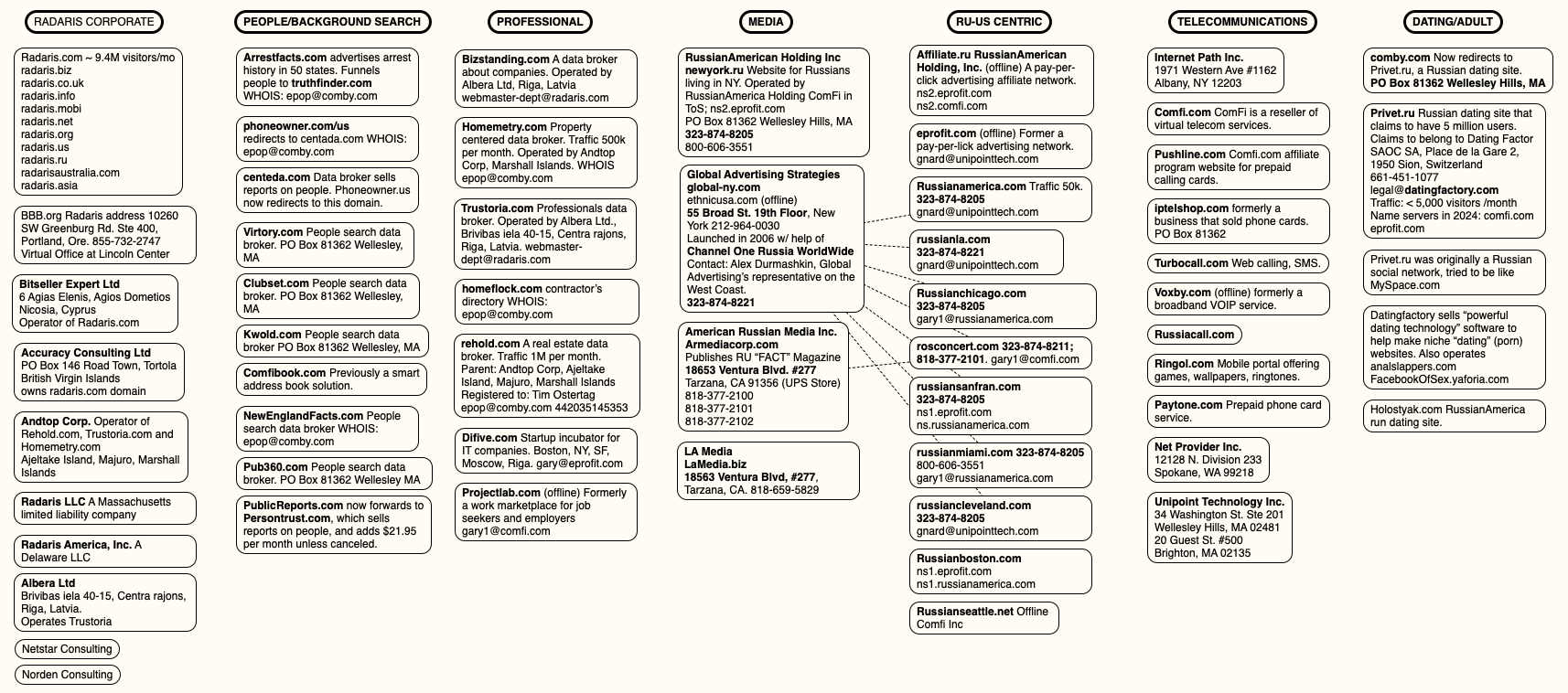
The internal communications demonstrate that a litany of nominal legal entities—including Radaris America, Inc.; Bitseller Expert Limited; Digital Orbit Corp; Core Solutions Group Inc.; Lucky Solutions Inc.; Virtura Corp.; Veripages Inc.; Nuform Solutions Inc.; Growth Data Advisors Inc.; and Property Experts, Inc.—were mere legal fictions. In reality, all were administered by a core group of three or four individuals operating out of a single virtual office address, sharing unified banking rails, and utilizing administrative infrastructure centered around the difive.com mail domain and its successor domains (centerex.com, scienteco.com, eprofit.com, realmo.com, and pub360.com).
Financial Yields and Cross-Industry Partnerships
Financial documents recovered by Atlas illuminated the immense profitability of the unregulated data broker ecosystem:
- Radaris.com generated an estimated $42,000 per month in direct consumer lookup fees.
- Veripages.com, a sister site within the network, grossed roughly $45,000 monthly through high-volume data-sharing and advertising partnerships with the Lifetime Value Company (operator of consumer search brands such as PeopleLooker, PeopleSmart, NumberGuru, and automotive history service Bumper).
- The Radaris network pulled in as much as $25,000 monthly through integration agreements with Onerep, a privacy-washing enterprise that ostensibly removes consumer data while simultaneously operating people-search sites like Nuwber.
Today, navigating to radaris.com bypasses the traditional lookup interfaces entirely, redirecting users instead to a formal notice published by Atlas detailing the court-mandated transfer of the domain.
Official Responses and Legal Posturing
The legal defense representing the remnants of the Radaris network has vowed to challenge the forfeiture on constitutional and procedural grounds.
Val Gurvits stepped back from direct commentary, noting that the defense portfolio had been reassigned to attorney Victor Worms. In statements responding to the court’s actions, Worms argued that the New Jersey court erred fundamentally by targeting a non-existent corporate entity.
"We have made a motion to vacate that default judgment on the grounds that it is void since a non-entity has no legal capacity to sue or be sued," Worms stated. "We also intend to pursue all appropriate appeals because we believe the transfer of radaris.com amounts to a forfeiture in violation of various constitutional principles."
Conversely, Raj Parikh, a partner at PEM Law and lead litigator for Atlas under Daniel’s Law, emphasized that the aggressive strategy was necessary to shatter a decade-long culture of impunity.
"In the past, they won by attrition," Parikh noted. "Plaintiffs’ attorneys tired of the procedural games and just gave up. That strategy worked for a decade, and it probably would have worked in this case too, since any financial recovery from foreign actors will be difficult. But we were acutely aware of the threat this website posed to law enforcement officers and other public officials in New Jersey, and decided early on to commit whatever time and resources were necessary to remove that threat."
Broader Implications: Daniel’s Law Under Constitutional Fire
While the seizure of radaris.com represents an unprecedented tactical victory for privacy advocates, the broader war over state-level data protection statutes is currently facing its ultimate constitutional test.
The Federal Court Challenges
Empowered by the success in New Jersey, data brokers have struck back en masse. Approximately 70 separate lawsuits filed by Atlas have been removed to federal court by data broker defense teams challenging Daniel’s Law as an unconstitutional overreach that violates First Amendment protections regarding the dissemination of publicly available information.
The U.S. Court of Appeals for the Third Circuit is expected to rule on the constitutionality of Daniel’s Law, with legal scholars anticipating an eventual appeal to the U.S. Supreme Court. The stakes extend far beyond New Jersey: at least 14 other states have enacted parallel legislation, while adversarial rulings—such as a federal district court decision in August 2025 striking down West Virginia’s version of Daniel’s Law as facially unconstitutional—highlight the fragility of state-by-state regulatory regimes.
The Federal Legislative Void
Privacy experts warn that state statutes, while effective in localized contexts, cannot solve systemic surveillance capitalism without comprehensive federal reform. Justin Sherman, a privacy researcher and author of the forthcoming book The Middlemen, points out that major technology firms, social media giants, cryptocurrency advocates, and AI developers have mounted intense lobbying campaigns to defeat federal privacy bills.
"These days at the federal level, add in the intense amount of lobbying against these laws from social media companies, big tech, cryptocurrency firms, and now AI proponents in the mix who claim that limiting their data scraping is somehow going to collapse the whole U.S. economy under Chinese rule," Sherman observed.
Sherman stresses that people-search businesses will continue to proliferate as long as state and federal privacy laws maintain broad exemptions for records categorized as "public" or "government" documents—including voting registries, property deeds, marriage licenses, motor vehicle files, court dockets, and professional licenses.
Without uniform federal limitations on how commercial entities harvest, aggregate, and monetize government-held records—exemplified by massive downstream security breaches like the recent compromise at IDScan.net, which exposed the driver’s license records of over 153 million Americans—piecemeal state laws will remain vulnerable to legal challenges.
"The average person can look at Daniel’s Law and have a perfectly normal reaction, which is that everyone should be covered, not just police and judges," Sherman concluded. "But we don’t need more wake-up calls. We’ve had eight million wake-up calls already on the need for better privacy laws. The lack of comprehensive federal privacy law is not for a lack of knowledge, and anyone claiming otherwise is either not reading the news or kidding themselves."
 Lina Irawan
 rifanmuazin
 Neng Nana
