
 By Jia Lissa

By Investigative Staff
In a stunning victory for digital privacy advocates and law enforcement protection, a New Jersey court has ordered the transfer of Radaris.com—one of the internet’s largest and most notoriously defiant consumer data broker and people-search domains—over to plaintiffs represented by Atlas Data Privacy Corp.
The forfeiture marks a catastrophic blow to a sprawling, multi-million-dollar empire of commercial surveillance that spent over a decade evading accountability through an intricate maze of international shell companies, fake executive profiles, and aggressive legal stonewalling.
The dramatic downfall of Radaris illuminates the high-stakes battle being waged over Daniel’s Law, a New Jersey statute designed to protect judges, law enforcement personnel, and government officials from targeted harassment and violence by scrubbing their personal information from the web. Yet, while this unprecedented court-ordered asset seizure signals a major milestone, it also underscores the deep systemic vulnerabilities plaguing American digital privacy in the 21st century.
Main Facts: The Fall of a Data Broker Giant
For years, Radaris.com operated with near-total impunity. Despite countless removal requests from everyday citizens and public officials alike, the platform maintained a reputation for ignoring compliance mandates while aggressively monetizing detailed personal dossiers on millions of Americans.
That calculus changed permanently when Atlas Data Privacy Corp. initiated legal action under Daniel’s Law. Enacted following a tragic family shooting involving the son of a federal judge, the statute permits state law enforcement officials, judges, and government personnel to demand the complete removal of their personal data from commercial aggregators. It imposes steep civil penalties of $1,000 per violation for companies that ignore these takedown requests.
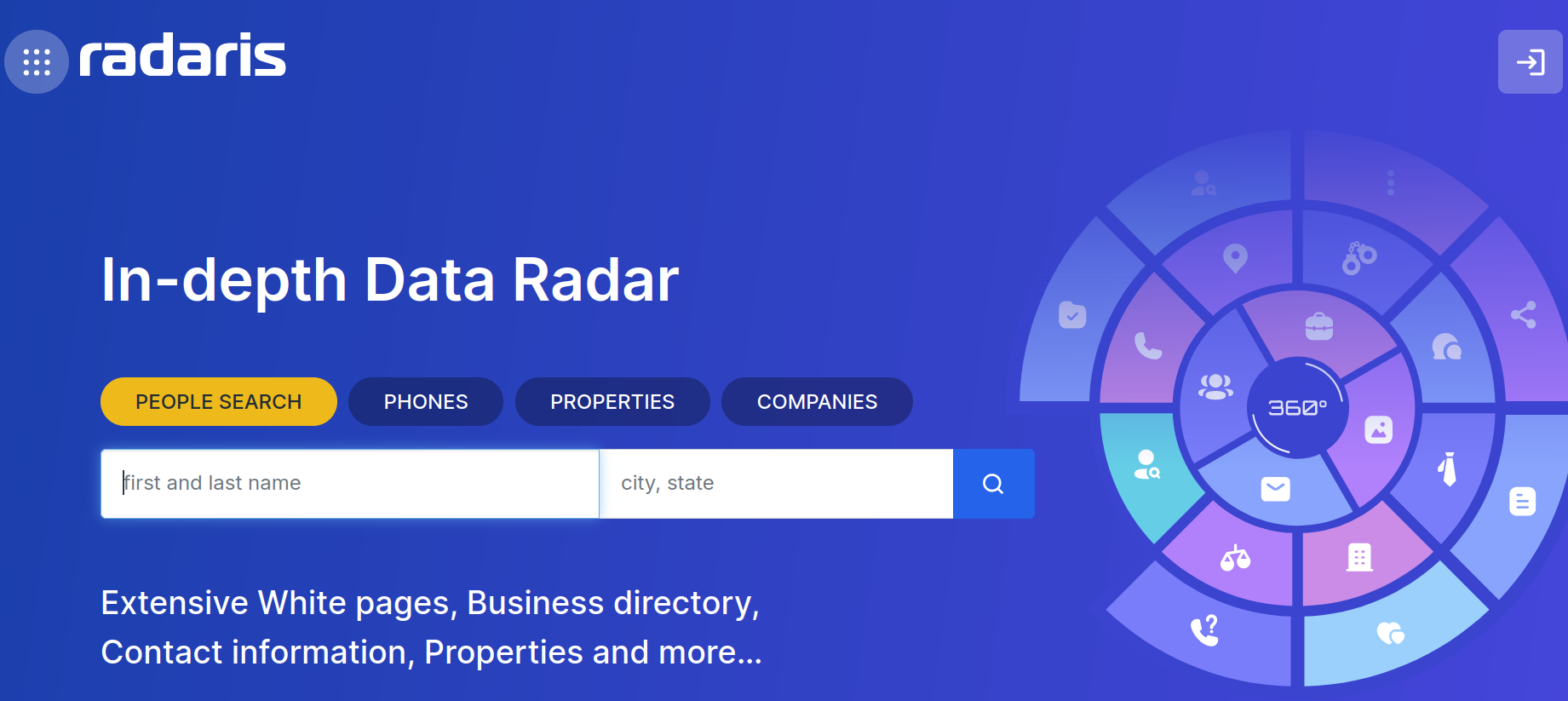
Facing mounting pressure and a persistent history of defiance, a New Jersey judge ordered the transfer of radaris.com—along with at least 14 other domains belonging to the Radaris family—directly to the plaintiffs. Rather than selling comprehensive background checks and personal records, the radaris.com homepage now displays a formal notice detailing the court-ordered domain transfer, alongside investigative reporting exposing the true architects behind the operation.
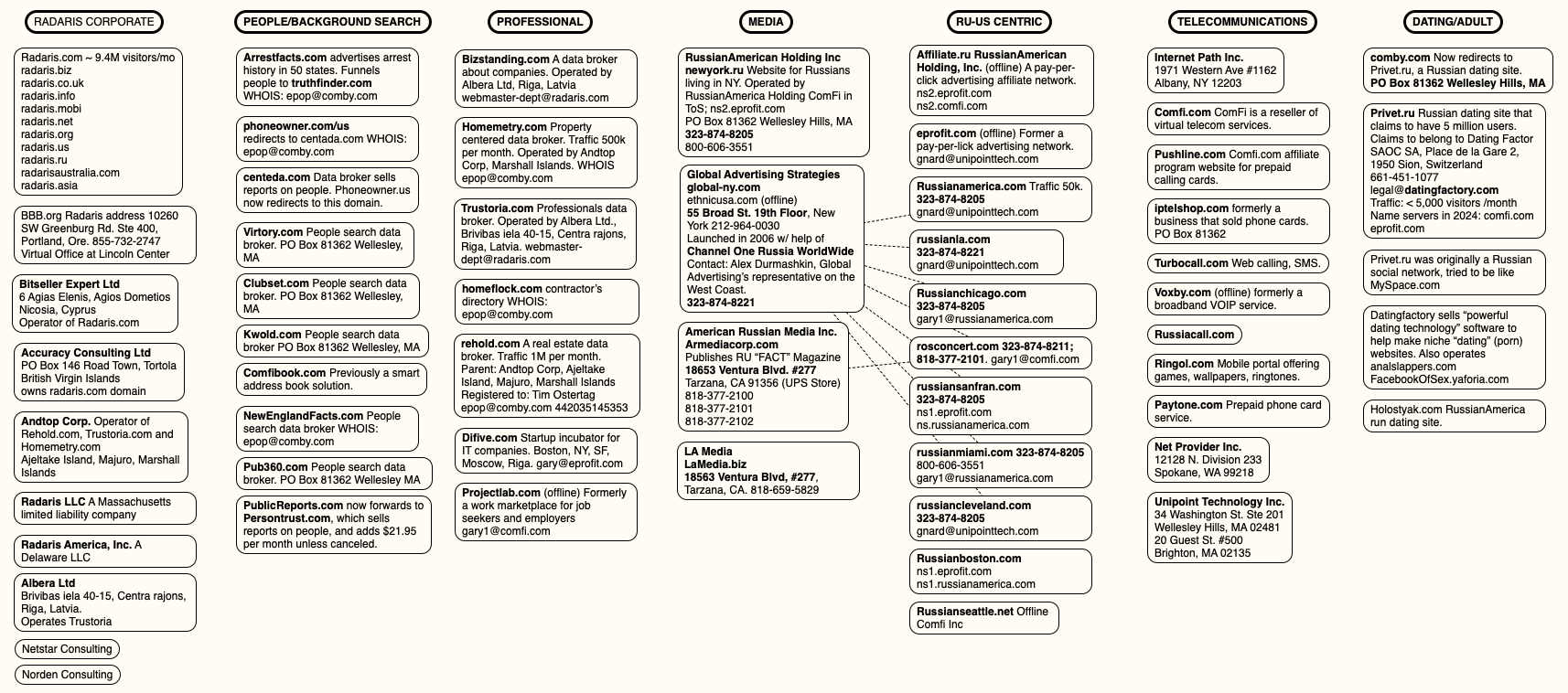
Internal communications and corporate records unearthed during the litigation reveal that Radaris was never a decentralized, multinational conglomerate. Instead, discovery documents demonstrate that at least 25 distinct people-search properties—including Veripages.com—were operated as a unified enterprise by a small, Boston-area group.
Financial disclosures extracted from the litigation reveal staggering revenues. Radaris.com reportedly pulled in approximately $42,000 a month, while sister site Veripages.com generated roughly $45,000 monthly through lucrative affiliate partnerships with major marketing conglomerates like the Lifetime Value Company (operator of PeopleLooker, PeopleSmart, NumberGuru, and Bumper). Furthermore, investigators discovered that the Radaris network earned up to $25,000 a month through partnerships with Onerep, a privacy-washing firm whose founders have similarly launched and operated parallel people-search networks.
Chronology of an Evasion: The Decade-Long Shell Game
The dismantling of Radaris follows a tortuous, decade-long cat-and-mouse game characterized by procedural delays, shifting corporate identities, and international corporate "island-hopping."
- 2017: Radaris defaulted in a class-action lawsuit (Huebner v. Radaris, LLC) after refusing to contest claims in court. When plaintiffs attempted to collect a $7.5 million default judgment, a federal court initially ordered Verisign to transfer the radaris.com domain name. Radaris attorneys successfully appealed, arguing that the domain was owned by a Cyprus-based entity called Bitseller Expert Limited, asserting that transferring the domain violated due process rights.
- Post-2017: Shortly after halting the domain transfer, the operational control of Radaris shifted from Bitseller to Andtop Company, an entity incorporated in the Marshall Islands in October 2020. The original plaintiffs never refiled, allowing the data broker to maintain its business model.
- February 2024: Atlas Data Privacy Corp. filed a fresh lawsuit against Radaris for violating Daniel’s Law.
- March 2024: Investigative reporting by KrebsOnSecurity unmasked the true operators of Radaris: Russian-born brothers Igor and Dmitry (Dan) Lubarsky, Massachusetts residents who manage a sprawling portfolio of people-search networks, affiliate marketing programs, and Russian-language dating portals. Radaris attorneys threatened a defamation lawsuit, falsely claiming the real owners were Ukrainian citizens living in Ukraine.
- June 2024: Follow-up reporting exposed that the Lubarsky brothers had utilized a fictitious CEO named Gary Norden to raise capital and issue press releases, a deception later acknowledged by Radaris’s legal counsel.
- June 2025: Following tactics where defense counsel claimed improper service and blamed non-existent entities, Atlas re-filed its lawsuit, dramatically expanding the scope of named sister companies. According to Atlas CEO Matt Adkisson, Radaris engaged in an "island-hopping phase," constantly shifting corporate domiciles to jurisdictions like the British Virgin Islands, Seychelles, and the Marshall Islands. Investigators later confirmed that one newly designated management entity in the Marshall Islands did not legally exist.
- August 26, 2025: Finding that the defendants had repeatedly squandered opportunities to mount a legitimate defense, the New Jersey court issued a decisive ruling, clearing the path for the immediate transfer of radaris.com and its sister domains to the plaintiffs.
Supporting Data: The Anatomy of a Surveillance Empire
The evidentiary corpus gathered by Atlas—comprising over 10,000 emails, financial records, and operational documents—shatters the illusion that Radaris was an untraceable foreign entity. The documents independently confirm that a constellation of nominal legal vehicles shared administrative, financial, and technical infrastructure.
The nominal corporate fronts identified in the litigation include:
- Radaris America, Inc.
- Bitseller Expert Limited
- Digital Orbit Corp
- Core Solutions Group Inc
- Lucky Solutions Inc
- Virtura Corp
- Veripages Inc.
- Nuform Solutions Inc.
- Growth Data Advisors Inc.
- Property Experts, Inc
According to plaintiffs’ filings, these disparate entities were universally administered by the same core group of individuals operating out of unified administrative channels. Their technical infrastructure—including mail servers hosted on domains such as difive.com, centerex.com, scienteco.com, eprofit.com, realmo.com, and pub360.com—tied the sprawling portfolio directly back to the Lubarsky brothers’ Massachusetts operations.
Raj Parikh, a partner at PEM Law representing Atlas, noted that Radaris historically survived by weaponizing legal attrition. "In the past, they won by attrition. Plaintiffs’ attorneys tired of the procedural games and just gave up," Parikh explained. "That strategy worked for a decade, and it probably would have worked in this case too… But we were acutely aware of the threat this website posed to law enforcement officers and other public officials."

Official Responses and Legal Posturing
Legal representatives for Radaris have strongly condemned the court’s actions, signaling that the fight is far from over.
Attorney Val Gurvits of the Boston Law Group, who previously represented Radaris and admitted to the invention of the fictitious CEO "Gary Norden," declined to comment on the latest developments, noting that the case had been reassigned to Victor Worms.
In response to inquiries, Worms maintained that the New Jersey court erred fundamentally by transferring the domain under a default judgment directed at "Radaris.com," which he asserted is not a recognized legal entity.
"We have made a motion to vacate that default judgment on the grounds that it is void since a non-entity has no legal capacity to sue or be sued," Worms stated. "We also intend to pursue all appropriate appeals because we believe the transfer of Radaris.com amounts to a forfeiture in violation of various constitutional principles."
Despite these legal challenges, the functional infrastructure of Radaris.com remains in the hands of privacy advocates, severely disrupting the automated generation of revenue and data harvesting that sustained the network for over ten years.
Broader Implications: The Future of Privacy Law and Daniel’s Law
While the seizure of Radaris.com is a monumental tactical win for privacy litigants, the broader legal war surrounding Daniel’s Law is entering a volatile phase.
Currently, Daniel’s Law faces an aggressive constitutional challenge. Approximately 150 consumer data broker firms targeted by Atlas have mobilized en masse, pushing at least 70 of these lawsuits into federal court. The data broker lobby argues that New Jersey’s statute is unconstitutionally broad and violates First Amendment protections regarding the dissemination of publicly available information. The U.S. Court of Appeals for the Third Circuit is actively reviewing these challenges, with industry observers anticipating that the case will ultimately reach the U.S. Supreme Court.
State-level momentum remains mixed. At least 14 other states have introduced or passed legislation modeled after Daniel’s Law. However, judicial headwinds persist; in August 2025, a federal district court ruled West Virginia’s iteration of Daniel’s Law facially unconstitutional under the First Amendment.
Privacy experts argue that state-by-state patchwork legislation cannot adequately address an industry built on systemic data exploitation. Justin Sherman, a privacy researcher and author of the forthcoming book The Middlemen, points out that tech lobbying groups, social media giants, cryptocurrency firms, and artificial intelligence proponents have formed a formidable coalition to defeat comprehensive federal data privacy legislation.
"These days at the federal level, add in the intense amount of lobbying against these laws from social media companies, big tech, cryptocurrency firms, and now AI proponents in the mix who claim that limiting their data scraping is somehow going to collapse the whole U.S. economy under Chinese rule," Sherman noted.
Sherman emphasizes that people-search engines will continue to proliferate as long as state and federal laws preserve broad exemptions for records categorized as "public" or "government" documents—including property filings, marriage certificates, voting registries, motor vehicle logs, criminal histories, and court documents. Without a comprehensive federal framework restricting how third-party vendors aggregate, cache, and monetize government data, piecemeal privacy laws will remain vulnerable to sophisticated evasion tactics.
"The average person can look at Daniel’s Law and have a perfectly normal reaction, which is that everyone should be covered, not just police and judges," Sherman concluded. "But we don’t need more wake-up calls. We’ve had eight million wake-up calls already on the need for better privacy laws. The lack of comprehensive federal privacy law is not for a lack of knowledge, and anyone claiming otherwise is either not reading the news or kidding themselves."
 Lina Irawan
 rifanmuazin
 Neng Nana
