
 By Basiran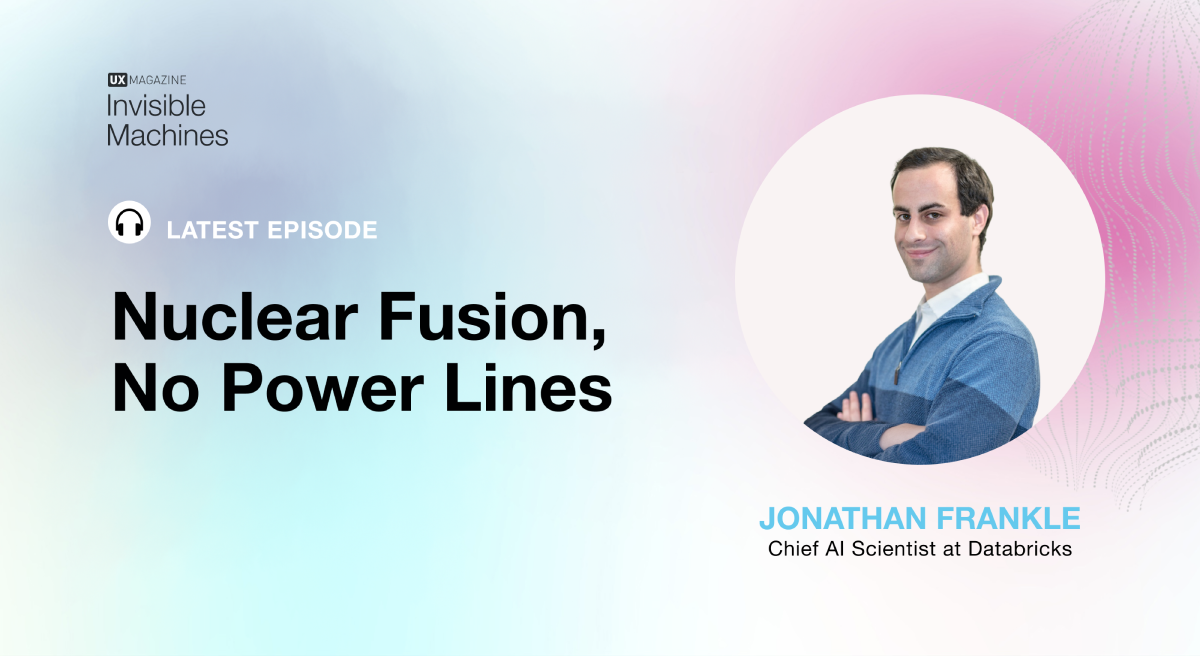
By UXM Editorial Desk
Published in Invisible Machines
Executive Summary: The Main Facts
Three years after he first appeared on Invisible Machines to demystify the art and science of "data mixology," Jonathan Frankle has returned with a starkly evolved diagnosis of the artificial intelligence landscape. Now serving as Chief AI Scientist at Databricks following MosaicML’s acquisition, Frankle offers a perspective forged from years of enterprise deployments and model training: the artificial intelligence community has successfully unlocked nuclear fusion, but we have completely forgotten to build the power lines.
In this context, "nuclear fusion" represents the raw, staggering capabilities of modern large language models (LLMs). These systems possess unprecedented generative capacity, multimodal processing power, and reasoning potential. However, just as nuclear fusion requires a complex grid of infrastructure to safely and reliably channel energy into homes and businesses, today’s AI requires an equivalent engineering grid—comprising precise specifications, rigorous testing disciplines, and composable tools—to bridge the gap between raw machine capability and ordinary human intent.
According to Frankle, the current AI ecosystem is languishing in its "Fortran days." While the underlying models improve exponentially, the developer tooling, verification frameworks, and architectural standards remain primitive. Organizations are attempting to build mission-critical enterprise systems using tools that lack the predictability and maturity of classical software engineering disciplines like Java, C, or Pascal.
Key takeaways from Frankle’s latest insights include:
- The Infrastructure Deficit: Raw model intelligence is outstripping our ability to specify requirements, test outcomes, and verify system behavior.
- The Fallacy of Benchmarks: Standard academic benchmarks (such as HellaSwag or broad leaderboards) remain largely disconnected from what end-users and enterprise customers actually require.
- Prompts as Parameters: Interacting with models via natural language is functionally a form of training; users are optimizing natural-language parameters rather than neural weights.
- The Rise of LLM Optimization (LLMO): Just as Search Engine Optimization (SEO) emerged to capture human search intent, a new discipline is taking shape to structure digital information for machine consumption and training pipelines.
Chronology: From the "Mini-Cupcake Ladder" to Enterprise Scale
2023: The Data Mixologist and the Betty Crocker Problem
When Jonathan Frankle—then serving as Chief Scientist at MosaicML—first joined Invisible Machines in 2023, the industry was obsessed with the sheer scale of pre-training data. During that conversation, Frankle introduced the "Betty Crocker problem" of language model training, popularizing the concept of "data mixology."
He used culinary analogies—such as climbing a "mini-cupcake ladder" before attempting to bake a full-scale wedding cake—to explain the delicate balance required to curate datasets. At the time, he cautioned against relying on academic benchmarks, arguing that high scores on abstract tests like HellaSwag offered zero correlation with whether a ChatGPT user would actually find a product useful. His methodology championed iterative experimentation, measuring small-scale successes before committing millions of dollars to cluster-level training runs.
2024–2025: The Integration Era and Databricks
Following MosaicML’s acquisition by data and AI giant Databricks, Frankle’s vantage point shifted dramatically. Instead of observing academic or boutique startup workflows, he found himself interacting with thousands of enterprise clients attempting to operationalize generative AI.
The challenges shifted from how to train models efficiently to how to govern, test, and integrate them into legacy corporate workflows. The scale changed, but the fundamental lessons remained intact. The industry moved past the initial gold rush of raw model releases into a sobering realization: deploying a foundational model into a Fortune 500 company without a software engineering grid leads to unpredictable, hallucination-prone operations.
Present Day: The Fusion Metaphor
Returning to Invisible Machines, Frankle summarized the current paradigm with an electrical engineering metaphor. The AI research community has achieved the impossible: sustained, high-yield artificial intelligence that generates remarkable cognitive outputs. Yet, practitioners are left trying to wire this nuclear reactor using frayed extension cords. The missing components—specification, testing, and determinism—represent the defining engineering bottleneck of the current generation.
Supporting Data, Perspectives, and Technical Analysis
1. The Analogy of Computing History: From Fortran to Java
Frankle’s critique of current AI development frameworks relies heavily on computing history. In the early days of programming, languages like Fortran allowed scientists to execute complex mathematical operations, but they were arduous to maintain, lacked structural safety, and required deep hardware-level awareness.
The breakthrough of later languages (such as Java, C, or Pascal) was not that they made computers more powerful, but that they gave human practitioners a comprehensible way to describe intent, edit code predictably, and verify execution through automated testing.
In contrast, modern prompt engineering and agentic workflows lack these foundational safety rails:
- No Unit Tests: There is no standard equivalent of a unit test that can guarantee an LLM will not hallucinate a critical business logic clause when prompted in slightly different ways.
- Opaque Abstractions: Natural language is notoriously ambiguous. Relying on English instructions to dictate complex software behaviors is akin to writing an operating system in a stream of consciousness.
- The Verification Gap: Building an evaluation set is not the same as formally defining system requirements. Most automated specification tools currently on the market fail to bridge this gap because they confuse data volume with structural clarity.
2. Context Windows and the Illusion of Infinite Memory
The industry’s relentless race toward million-token context windows has created a dangerous corporate temptation: the "document dump." Many organizations assume that the solution to enterprise knowledge management is simply feeding decades of uncurated PDFs, messy spreadsheets, and outdated emails directly into an expansive context window or Retrieval-Augmented Generation (RAG) pipeline.
Frankle warns that this approach violates the core tenets of data hygiene:
- Garbage In, Garbage Out: Whether bad data enters through pre-training, RAG retrieval, or direct prompt stuffing, the model will process it with equal weight.
- Distractor Degradation: Empirical evidence shows that model performance can actually degrade as context lengths increase due to the introduction of distractor tokens, imperfect relevance judgments, and the fundamental limitation that models are not omniscient.
- The Need for Curation: Enterprises cannot bypass the hard work of data curation simply because models have larger memory capacities. Wrong answers buried in unread internal files will simply be synthesized into confident falsehoods at scale.
3. Prompts as Parameters
One of the most profound conceptual reframes offered in the discussion is the equivalence between prompting and training. When an engineer interacts with models like Claude or GPT-4 via prompt engineering, they are effectively engaged in a training exercise.
Instead of updating the underlying neural network weights via backpropagation, the practitioner is optimizing natural-language parameters. This realization highlights a systemic product design loop: software developers are building graphical user interfaces (GUIs) whose sole purpose is to construct a written prompt—essentially wrapping old text-based media inside new interface paradigms in a classic McLuhanesque loop.
Official Responses and Industry Reactions
As enterprise adoption matures, software architects, platform builders, and enterprise leaders have begun reacting to the infrastructure deficit outlined by Frankle.
- The Platform Dilemma: Enterprise platform engineers report a growing tension between the desire to deploy autonomous AI agents and the lack of visual and programmatic back-ends required to verify what those agents have actually accomplished. Natural language generation is easy to trigger, but auditing execution pathways remains a black box.
- The Shift Toward Rigorous Evaluation: Leading AI laboratories and enterprise software providers are increasingly shifting investments away from raw parameter scaling and toward automated alignment, guardrail enforcement, and deterministic testing frameworks.
- The Rejection of Leaderboard Hype: Echoing Frankle’s long-standing skepticism of academic benchmarks, enterprise procurement teams are pivoting away from public leaderboard rankings. Organizations are increasingly relying on custom, domain-specific evaluation harnesses that reflect their specific operational constraints.
Implications for Enterprises, Brands, and Content Creators
The maturation of generative AI carries profound implications that extend far beyond Silicon Valley labs, directly impacting corporate strategy, software engineering, and digital publishing.
1. The Rise of LLM Optimization (LLMO)
As AI models increasingly serve as the primary interface through which consumers discover information, products, and services, the traditional rules of the digital landscape are rewriting themselves. Frankle predicts the emergence of a robust "LLM optimization" cottage industry, functioning as the modern successor to Search Engine Optimization (SEO).
Key strategic pivots for brands and enterprises will include:
- Curated Canonical Facts: Enterprises will need to maintain pristine, verified repositories of factual data, separating stable corporate truths from tentative draft documents.
- Machine-Readable Publishing: Content published on the open web is no longer written solely for human readers and traditional web crawlers; it serves as a direct or indirect training signal for the next generation of models and autonomous agents.
- Decoupling Knowledge from Reasoning: In an ideal architectural future, organizations would cleanly separate core business guidelines and proprietary knowledge from a faithful, immutable reasoning engine. Until the industry achieves this clean split, enterprises must learn to operate safely inside trillion-parameter uncertainty.
2. A Shift in Scientific Values
Beyond technical frameworks, Frankle’s career trajectory offers a cultural lesson for the tech industry. While his early academic fame was cemented by theoretical breakthroughs like the "lottery ticket hypothesis," his most enduring professional satisfaction stems from practical, high-impact work—such as his pre-PhD empirical report on police use of facial recognition technology that successfully changed legislation.
This value system directly informs his advice to contemporary AI practitioners:
- Less Hype, More Experiment Design: The industry must move away from breathless prognostications about imminent Artificial General Intelligence (AGI) and focus instead on rigorous, repeatable experiment design.
- Pragmatic Engineering: The true measure of an AI scientist is not citation counts or leaderboard dominance, but the reliability and societal utility of the systems they deploy. The question for the next decade is not how large we can make the model, but what kind of dependable blender we are building next to integrate it smoothly into human workflows.
For further exploration of these concepts, access the Ideation Hub or read the Full Episode Transcript.
 Ammar Sabilarrohman
  Neng Nana
  Sagoh
Sagoh 