
 By Iffa Jayyana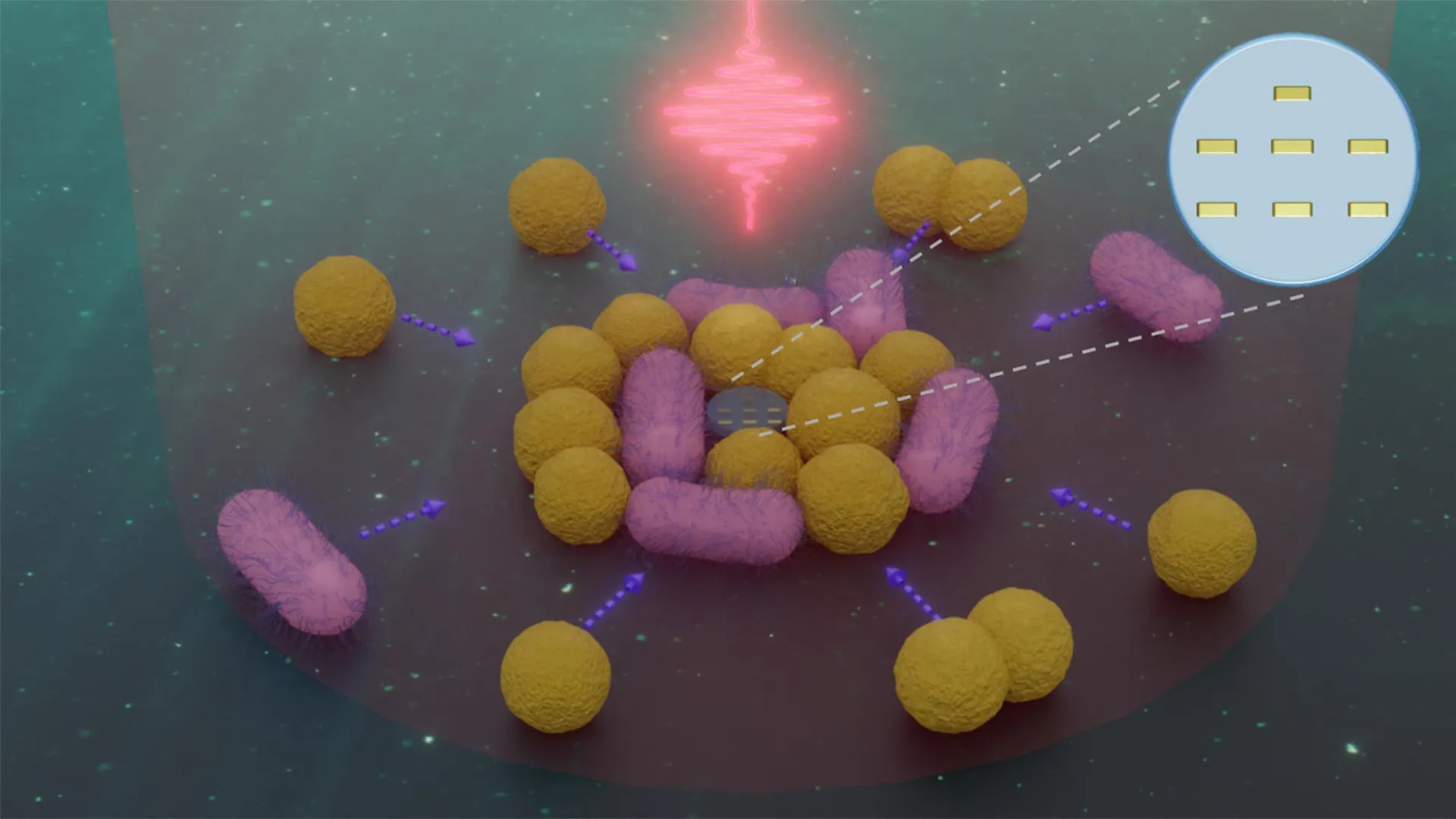
In a breakthrough that bridges the gap between science fiction and tangible engineering, researchers at Julius-Maximilians-Universität Würzburg (JMU) have unveiled a new class of light-powered nanorobots capable of navigating the microbial world with unprecedented precision. These machines, which measure less than one micrometer—roughly 50 times smaller than the diameter of a human hair—represent a monumental leap in our ability to interact directly with the building blocks of biological life. By harnessing the physical force of light itself, scientists have created "microscopic cleaners" capable of capturing, transporting, and depositing individual bacteria, potentially transforming fields ranging from biomedical research to environmental remediation.
The Main Facts: Manipulating the Invisible
For decades, the microscopic world has been a domain of observation rather than interaction. While microscopes have allowed us to peer into the life of cells and bacteria, the physical act of manipulating these entities has remained a formidable engineering hurdle. Traditional robotic systems are far too cumbersome and energy-inefficient to operate at the sub-micron scale, where the physics of fluids and gravity behave in ways that defy human-scale intuition.
The JMU team, led by Professor Bert Hecht, has effectively bypassed these constraints by developing nanorobots that function as autonomous agents in liquid environments. These devices utilize plasmonic nanoantennas to interact with light, turning the pressure of photons into a propulsion mechanism. Unlike traditional motors or electrical actuators, which require complex wiring or internal power sources, these robots draw their energy entirely from an external light source, allowing them to remain miniaturized and highly agile.
Chronology: From Theoretical Physics to Practical Application
The journey to this discovery has been marked by a decade of rigorous inquiry into the interaction between light and matter at the nanoscale.
The Foundation (2014–2018)
The project began as an exploration into "plasmonic nanoantennas"—structures capable of concentrating light into extremely small volumes. Early experiments focused on whether the recoil force of light could be harnessed to generate motion in microscopic particles. Initial prototypes were larger and lacked the sophisticated steering mechanisms required for complex tasks.
The Breakthrough (2019–2022)
By 2020, the team successfully demonstrated that light could act as both an engine and a steering wheel. Through the strategic placement of nanoantennas, they achieved controlled movement in two dimensions. However, the size of the robots remained a limitation, as they were often too bulky to move through dense microbial colonies.
The Current Milestone (2023–2024)
In the most recent iteration of their research, the team achieved a significant reduction in size. By simplifying the structural design and integrating the steering mechanism directly into the antenna wires, they produced a device smaller than one micrometer. This breakthrough enabled the robots to interact with bacteria at the same scale as their biological counterparts, leading to the successful demonstration of "micro-cleaning" tasks where the robots actively gathered and relocated bacterial samples.
Supporting Data: The Physics of Photon Recoil
The engine behind these nanorobots is a phenomenon rooted in fundamental physics: the conservation of momentum.
- Propulsion via Recoil: The microdrones are equipped with up to four plasmonic nanoantennas. When these antennas absorb a photon of a specific wavelength and helicity, they re-emit it in a precise direction. According to Newton’s Third Law, this redirection creates a recoil force. While a single photon provides an infinitesimal amount of force, the high rate of photon emission creates a sustained thrust that, given the extremely low mass of the nanorobot, results in significant acceleration.
- Steering Mechanism: The researchers integrated nanoscale antenna wires that naturally align with the polarization of incoming light. By modulating the polarization of the light source, the researchers can "steer" the nanorobot, effectively changing its orientation without the need for onboard batteries or complex mechanical rudders.
- Performance Metrics: The nanorobots are capable of making rapid 90-degree turns, allowing for the organized scanning of microscopic environments. Even when loaded with biological cargo, the drones maintain maneuverability, though they experience a predictable decrease in maximum velocity due to the increased drag and mass of the bacterial clusters.
Official Responses: Insights from the JMU Team
The research team emphasizes that the success of the project is not just in the creation of the robots, but in the shift in philosophy regarding how we treat the microscopic world.
Jin Qin, the lead experimental scientist on the study, highlights the transition from passive observation to active participation: "In essence, we have built a light-driven nanorobot that can track down and collect bacteria. By simplifying the design, we reached a size at which these robots can operate directly in the microbial world—almost like microscopic cleaning devices."
Professor Bert Hecht, who oversaw the development, contextualizes the achievement within the broader landscape of modern science. "This is a striking example of how light can be used not only to observe the microscopic world, but also to actively shape it," Hecht stated. "The idea of tiny robotic cleaners may sound futuristic, but we are already demonstrating the physical principles that make it possible."
Implications: A New Frontier in Science and Medicine
The ability to manipulate individual bacteria and cells opens a plethora of doors in various scientific disciplines.
Revolutionizing Biomedical Research
Currently, isolating individual cells for study is a labor-intensive process that often requires specialized microfluidic chips. These nanorobots could provide a more fluid, dynamic way to perform single-cell analysis. By selectively capturing specific cells, researchers could move them to isolated chambers for further examination without disrupting the surrounding biological environment.
Environmental Remediation
The concept of a "microscopic cleaner" has profound implications for environmental science. In theory, these robots could be deployed in water treatment facilities to seek out and remove specific contaminants, including harmful bacteria or microplastics. Their ability to operate in aqueous environments makes them uniquely suited for water-based filtration tasks that were previously impossible.
Precision Material Science
Beyond biology, these nanorobots offer a blueprint for the future of nanofabrication. By using light to precisely position sub-micron components, engineers could eventually assemble complex circuits or nanostructures that are too small for conventional pick-and-place robotics.
Future Challenges and Ethical Considerations
Despite the excitement, the path to commercial or clinical application is not without obstacles. The current need for a sophisticated, external light setup means these robots are largely confined to laboratory settings. Furthermore, researchers must address the longevity of these devices in complex, non-sterile environments where they might be prone to fouling or chemical degradation.
Ethically, the ability to control biological entities at the cellular level necessitates a rigorous conversation about the future of nanotechnology. As these devices become more autonomous, the boundary between "instrument" and "agent" will continue to blur, requiring a framework for the safe and responsible deployment of micro-robotics.
Conclusion: Looking Toward the Future
The research conducted at JMU is a testament to the power of fundamental physics when applied with creative engineering. By turning the vacuum of space’s laws into the building blocks of a micro-engine, the team has provided a glimpse into a future where the microscopic world is no longer a vast, unreachable landscape, but a workspace that can be navigated, organized, and cleaned.
While the "microscopic cleaners" are currently a marvel of the laboratory, the core principles established by Professor Hecht and his team are likely to serve as the foundation for the next generation of nanotechnologies. As the size of these machines continues to shrink and their control systems grow more sophisticated, we move ever closer to a world where we can operate with the same dexterity at the level of the cell as we do at the level of the human hand. The tools to build the future are not just becoming faster or stronger—they are becoming smaller, driven by the very light that allows us to see them.
 Ammar Sabilarrohman
  Laily UPN
  Evan Lee Salim