
 By Asro
By Smashing Editorial
Executive Summary & Main Facts
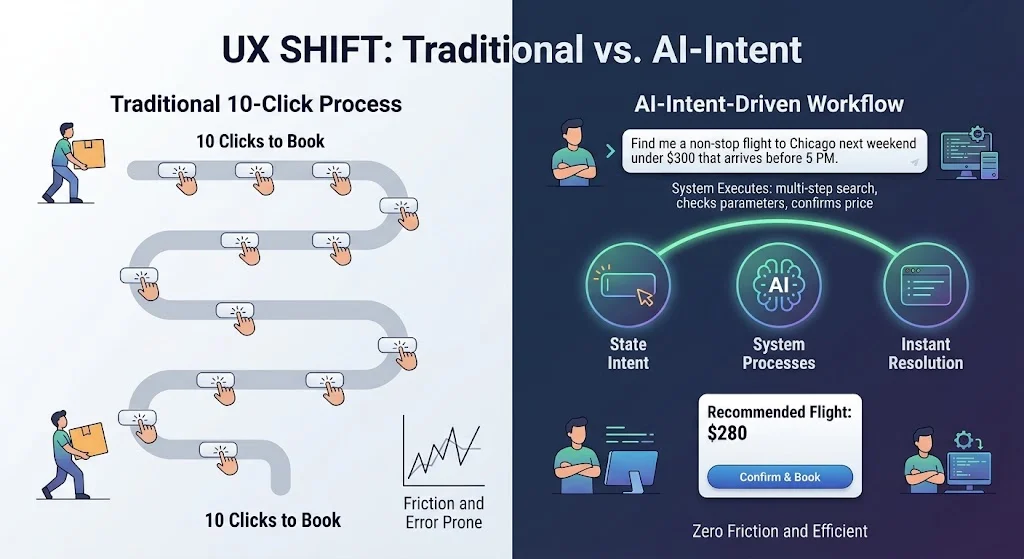
For over forty years, the commercial digital landscape has been built on a fundamental trade-off: humans must learn the mechanics of software to make it work. Ever since the commercialization of the Graphical User Interface (GUI), pioneered by systems like the Xerox Star and popularized by the original Apple Macintosh, software has relied heavily on point-and-click interactions.
Today, that foundational contract is breaking down. Driven by rapid advances in artificial intelligence, machine learning, and large language models (LLMs), a new paradigm is taking over the web: Intent-Driven Design.

Rather than forcing users to navigate complex sales funnels, toggle range sliders, decode multi-step forms, and manage dozens of open browser tabs, modern web applications capture high-level human goals and silently execute the heavy lifting in the background. As the digital industry embraces concepts from Golden Krishna’s The Best Interface Is No Interface and Don Norman’s human-centered design principles, the ultimate objective of web design is no longer crafting prettier buttons or flashier animations—it is eliminating the interface entirely.
A Brief Chronology: From Punch Cards to Intent-Driven Web Platforms
To understand how web design reached this pivotal crossroads, it is necessary to trace the evolution of human-computer interaction (HCI) across generations:
- The Command-Line Era (1950s–1970s): Computing required absolute precision. Users had to memorize and type rigid syntax commands into text terminals. The cognitive load was entirely on the human to speak the computer’s language.
- The GUI Revolution (1980s–1990s): The Xerox Star, Apple Macintosh, and Microsoft Windows introduced desktops, files, and clickable buttons. This visual metaphor bridged the gap between human intuition and machine operation, making computing accessible to the mainstream.
- The Web & Point-and-Click Proliferation (2000s–2010s): The rise of the web brought interactive menus, sidebars, multi-step checkout funnels, and cookie pop-ups. Software evolved into a passive container of data, forcing humans to act as meticulous orchestrators, manually driving every micro-action.
- The Conversational & Prompt Era (Early 2020s): Early LLMs introduced conversational UIs. While powerful, text boxes alone often felt clunky, forcing users to type out lengthy prompts for tasks that could historically be achieved with a single glance or click.
- The Intent-Driven & Generative UI Era (Present & Beyond): We are now transitioning into an era where software relies on ambient metadata, context, and high-level goal submission. Interfaces are no longer static templates; they are generated dynamically on the fly to fulfill an immediate objective, then dissolve when the job is done.
Supporting Data & Real-World Implementations
This transition from manual interaction to automated execution is no longer a theoretical exercise confined to academic labs. Several platforms have already demonstrated how intent-capturing systems replace traditional buttons and navigation trees.
1. Perplexity AI: Search Without the Open Tabs
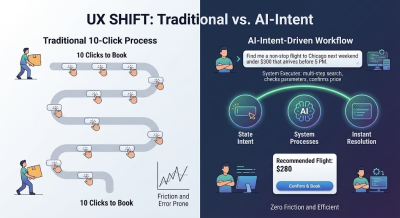
Traditional search engines like Google were historically built as directories. A user entered a keyword and received a list of ten blue links. The cognitive labor—opening five different tabs, skimming long articles, dodging intrusive ads, and manually synthesizing an answer—was left entirely to the human.
Platforms like Perplexity AI bypass this friction by allowing users to perform instant intent-based searches. Instead of navigating multiple tabs, the interface synthesizes the required data into a single, cohesive, context-aware answer.
2. Vercel v0: Web Design Without Dragging and Dropping
For years, creating digital products meant spending countless hours inside design systems like Figma or visual web editors, manually drawing rectangles, picking hexadecimal color codes, adjusting padding values, and writing CSS code.
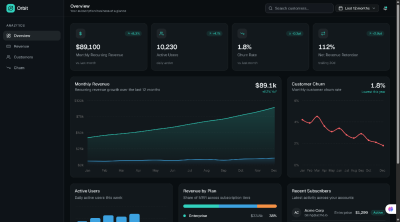
Tools like Vercel v0 allow users to test generative interface building directly from a simple text prompt. By expressing a high-level design goal—such as "Build a clean SaaS dashboard with real-time analytics and a dark mode toggle"—the platform instantly generates functional UI components and production-ready code.
3. Goblin.tools: Breaking Down Overwhelming Tasks
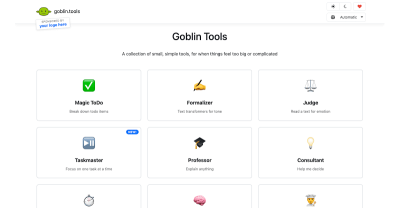
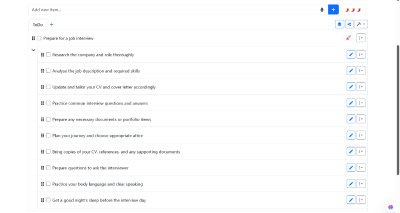
Traditional productivity tools require users to manually construct task lists, drag items across complex Kanban boards, and assign micro-deadlines. Goblin.tools offers a free, single-page suite of AI-powered micro-tools designed to take a vague, overwhelming statement (e.g., "Plan a job interview") and automatically deconstruct it into a step-by-step, manageable checklist.
Core Pillars of Intent-Driven Web Design
When traditional menus, sidebars, and fixed forms are stripped away, how do web applications remain usable? Pioneers in this space rely on three foundational pillars:
| Pillar | Traditional UX Approach | Intent-Driven UX Approach |
|---|---|---|
| 1. User Input | Micro-actions (Clicks, dropdowns, toggles) | High-level goals (Natural language, context, habits) |
| 2. Interface State | Static layouts (Every visitor sees the exact same page) | Generative UI (Layouts created dynamically on the fly) |
| 3. Task Execution | Manual execution by the human user | Autonomous execution by background AI agents |
Pillar 1: High-Level Goals & Contextual Awareness
An invisible interface does not always wait for a direct text command. Drawing inspiration from standards like Apple’s Human Interface Guidelines on Contextual & Ambient Design, modern web applications read environmental metadata—such as device states, physical locations, and historical interaction patterns—to trigger proactive actions. Instead of asking a user to manually configure settings every time they travel or change environments, the software adapts seamlessly.
Pillar 2: Generative UI
In legacy web design, an e-commerce platform displays the exact same navigation bar whether the user is a first-time visitor seeking customer support or a loyal customer tracking an existing order.
As highlighted by the Nielsen Norman Group’s analysis of AI as a new UX paradigm, computing is shifting from command-based interaction to outcome-specification. This enables Generative UI, where interfaces are rendered dynamically on the fly based on what the user is trying to accomplish at that exact micro-second. If a user expresses a desire to evaluate complex financial scenarios, the interface generates a dynamic calculator widget on demand, which then recedes once the goal is achieved.
Pillar 3: Autonomous Execution by AI Agents
Traditional software is obsessed with error prevention, constantly bombarding users with redundant confirmation modals ("Are you sure you want to delete this file?").
Intent-driven interfaces adapt Jakob Nielsen’s 10 Usability Heuristics on User Control and Error Recovery by shifting the safety net from prevention to easy reversibility. Because autonomous agents execute actions on behalf of the user, applications prioritize frictionless rollback mechanisms—such as prominent "Undo" buttons, simple revision prompts ("Make this summary shorter"), and transparent audit logs—over intrusive warning pop-ups.
Official Industry Responses & Design Frameworks
As the UX community grapples with the transition from visual screen architecture to invisible orchestration, leading research institutions and industry bodies have published formal guidelines:
- The Stanford HCI Group: Researchers emphasize that as automation handles more background execution, maintaining clear boundaries is essential to prevent users from feeling patronized or disoriented by unprompted software behavior.
- The Center for Humane Technology: Advocacy groups stress that product designers must guard against manipulative defaults, ensuring that intent-driven systems serve human well-being rather than maximizing mindless engagement metrics.
- Google PAIR (People + AI Research) Guidebook: To combat the "black box problem"—where users cannot diagnose why an AI made a specific decision—the PAIR guidebook advocates for transparent feedback loops. Systems must explicitly state their interpretation ("Searching for non-stop flights to Chicago under $300…") so users can calibrate trust and correct misinterpretations instantly.
Implications for UX Designers and the Digital Industry
For UX designers, this evolutionary leap requires a complete re-evaluation of our role. As the industry moves away from designing static buttons and rigid forms, practitioners must learn to map and present dynamic, generative UI components that adapt fluidly to human intent.
The Illusion of Control vs. Frictionless Completion
When software makes decisions on behalf of users, it introduces critical ethical and technical challenges. Designers must strike a delicate balance: automate routine execution, but explicitly prompt the user for high-stakes confirmations (such as financial transactions, publishing public content, or altering privacy settings).
Re-evaluating Digital Success Metrics
For decades, the digital industry evaluated software success through engagement metrics like time spent in app, click-through rates, and page views per session. Websites were deliberately engineered to maximize visual engagement and interaction volume.
The philosophy behind Golden Krishna’s The Best Interface Is No Interface, aligned with the Center for Humane Technology’s "Time Well Spent" movement, turns these outdated metrics on their head. The ultimate test of a modern digital product is no longer how visually captivating its buttons are, but rather: How effectively did this software solve the problem and get out of the user’s way?
Conclusion
We are entering an era where web applications will no longer be measured by the beauty of their static interfaces, but by their ability to render those complex interfaces completely obsolete. The future of the web is not more interaction—it is seamless, invisible completion.
 Nila Kartika Wati
 Evan Lee Salim
 Reynand Wu
