
 By Nila Kartika Wati
Every digital agency, product team, and independent founder knows a universally accepted, yet unspoken truth: a website is never more vibrant, flawless, and perfectly aligned with its brand than it is on launch day.
The final branch merges, DNS propagates, and the site goes live. For a brief, shining moment, it is immaculate. Yet, from that exact second onward, a slow, invisible decay begins. This erosion has nothing to do with broken links or server outages; rather, it stems from the relentless march of time. Markets shift, competitors launch disruptive features, messaging evolves, and design systems mature. Within a year, a meticulously crafted website can easily devolve into a digital period piece—fully functional, yet fundamentally behind.
Historically, product teams have treated this decay as an unalterable law of nature. Keeping a website continuously updated requires a massive, ongoing allocation of human capital—resources that most organizations would rather dedicate to core product development.
However, the rise of autonomous artificial intelligence agents promises to rewrite this paradigm. By continuously optimizing websites after launch, these agents aim to liberate human teams from the Sisyphean task of endless maintenance. But as platform developers and early adopters quickly discover, taking the concept of full website autonomy seriously exposes a profound paradox: almost nobody actually wants a website that changes entirely on its own.
Main Facts: The Autonomous Web Paradigm and the Trust Deficit
The core thesis driving platforms like Fimo is simple: websites should improve over time rather than degrade. In an idealized autonomous web ecosystem, an AI agent catches that last week’s design-system token updates failed to propagate to the pricing page and fixes them overnight. Another agent detects uncompressed image assets shipped during a rushed deployment and automatically optimizes them. A third flags accessibility regressions introduced by a newly deployed component, resolving them or queuing them for human review.
Yet, implementing this vision encounters an immediate psychological and organizational barrier. While the technology required to grant agents total editing and publishing privileges is rapidly maturing, human stakeholders universally hesitate to hand over the keys.
According to Pierre Burgy, co-founder of Fimo, this hesitation does not stem from a distrust of AI capabilities, but rather from a fundamental organizational reality: websites have no single owner.
Different segments of a web property belong to different stakeholders—designers, developers, content marketers, and brand executives—each with a vastly different tolerance for automation. Consequently, the primary engineering challenge of the autonomous web is not building smarter algorithms, but establishing granular, highly customizable boundaries of control.
Chronology: From the Dream of Full Automation to Granular Control
The evolution of autonomous web platforms offers a fascinating case study in product development driven by user feedback.
Phase 1: The Assumption of Total Autonomy
When developers first began applying advanced LLMs and specialized agents to web infrastructure, the prevailing assumption was absolute: hand the agents the keys to the entire site. Let them write code, edit copy, optimize assets, and push updates autonomously. The goal was to remove humans from the loop entirely, positioning autonomy as a complete replacement for manual website maintenance.
Phase 2: The Reality of User Hesitation
When early versions of autonomous platforms were placed in front of real-world teams, the expected enthusiasm was met with sudden hesitation. Users did not lean into total automation; they pulled back. Teams worried about unauthorized copy changes, broken brand identities, and unexpected visual regressions. The "black box" nature of early autonomous systems created an unacceptable risk profile for businesses whose websites served as their primary digital storefronts.
Phase 3: The Pivot to Composable, Role-Based Agents
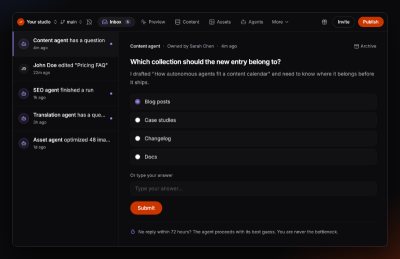
Recognizing that absolute autonomy was a false idol, platform architects pivoted. They abandoned the binary toggle of "approve versus delegate" in favor of composable, purpose-built agents. Rather than treating the website as a monolithic entity, developers built specialized units—such as content agents, translation agents, and asset optimization agents—allowing teams to draw custom lines of autonomy tailored to individual organizational roles.
Supporting Data: Categorizing the Modern Web Workload
To understand why traditional, all-or-nothing automation fails, experts break down the modern website workload into three distinct categories:
+--------------------------------------------------------------------------+
|                        THE WEBSITE WORKLOAD SPECTRUM                     |
+------------------------------+-------------------------------------------+
| 1. The Chores (approx. 80%)  | Rule-bound, repetitive, non-subjective.   |
|                              | (Alt text, meta tags, image compression)  |
+------------------------------+-------------------------------------------+
| 2. The Core Value (Small %)  | Subjective, brand-defining, creative.     |
|                              | (Visual identity, tone of voice, ethos)   |
+------------------------------+-------------------------------------------+
| 3. The Gray Area             | Depends entirely on organizational role.  |
|                              | (Default dark mode, feature flags, copy)  |
+------------------------------+-------------------------------------------+
1. The Chores (The Rule-Bound 80%)
The vast majority of website maintenance consists of tasks that are completely rule-bound and devoid of creative expression:
- Ensuring accessibility (WCAG) compliance as page layouts shift.
- Propagating design token changes across disparate components.
- Catching broken meta tags, missing alt attributes, or rotted hyperlinks.
Nobody is hired for their creative genius in spotting missing alt attributes. This is the low-hanging fruit of automation—tedious work that humans are actively relieved to offload, and that agents excel at because it is governed by deterministic rules rather than subjective taste.
2. The Untouchable Core (The Sanctuary of Taste)
At the opposite end of the spectrum lies work that cannot be delegated at any price. An agent can verify contrast ratios, heading orders, and style-guide adherence, but it cannot determine what a page should feel like or whether a design possesses genuine aesthetic merit. This subjective judgment is precisely why human creative professionals are hired, and protecting this domain is paramount.
3. The Gray Area (Role-Dependent Boundaries)
Between pure chores and untouchable creative work lies a vast gray area where the line of autonomy shifts depending on who is asked. Consider a practical example: configuring dark mode as the default user landing experience.
- To a front-end developer, this is a logical, one-line rational adjustment that an agent can safely apply and deploy.
- To a brand designer, the default theme is a foundational statement about how the brand introduces itself to the world, demanding careful human deliberation.
The same task carries entirely different weights of judgment depending on the stakeholder, proving that a universal automation setting is inherently impossible.
Official Perspectives and Industry Insights
Industry leaders emphasize that the true promise of web autonomy has been widely misunderstood.
"The point of autonomy was never to remove you from your website. It was to remove the decay." — Pierre Burgy, Co-Founder of Fimo
According to platform architects, building trust in autonomous systems requires radical transparency. Modern agentic platforms do not operate in the shadows; they maintain exhaustive audit trails, historical logs, and granular before-and-after change previews. When an agent quietly corrects an overlooked error and provides a clear audit log of its actions, human trust grows organically.
Furthermore, trust is dynamic rather than static. As agents prove their reliability over time, boundaries naturally expand. Tasks that initially required strict human sign-off can gradually be delegated to unattended execution, moving the needle toward maximum efficiency without sacrificing security or brand integrity.
Implications: The Future of Web Engineering and Maintenance
The shift toward agentic, continuously optimized websites carries profound implications for the digital landscape:
- The Death of the "Redesign Cycle": Traditionally, companies endure a painful, expensive website redesign every three to five years to combat accumulated decay. Autonomous websites flatten this cycle into a state of perpetual, incremental evolution.
- Redefining Digital Roles: Developers and designers will transition from manual implementers and QA checkers to agent supervisors, defining the boundaries within which autonomous systems operate and focusing their energy exclusively on high-impact strategic decisions.
- The Risk Profile Inversion: While early critics feared that autonomous agents would inadvertently break production environments, the industry is realizing that the true existential risk lies in the opposite direction: the frozen, static website that slowly falls into irrelevance while its owners look away.
Ultimately, the future of the web belongs neither to fully manual workflows that inevitably succumb to decay nor to reckless, unmonitored hyper-automation. It belongs to composable, collaborative intelligence—where human vision sets the standard, and autonomous agents tirelessly hold the line against obsolescence.
 Evan Lee Salim
 Reynand Wu
