
 By Nana Muazin
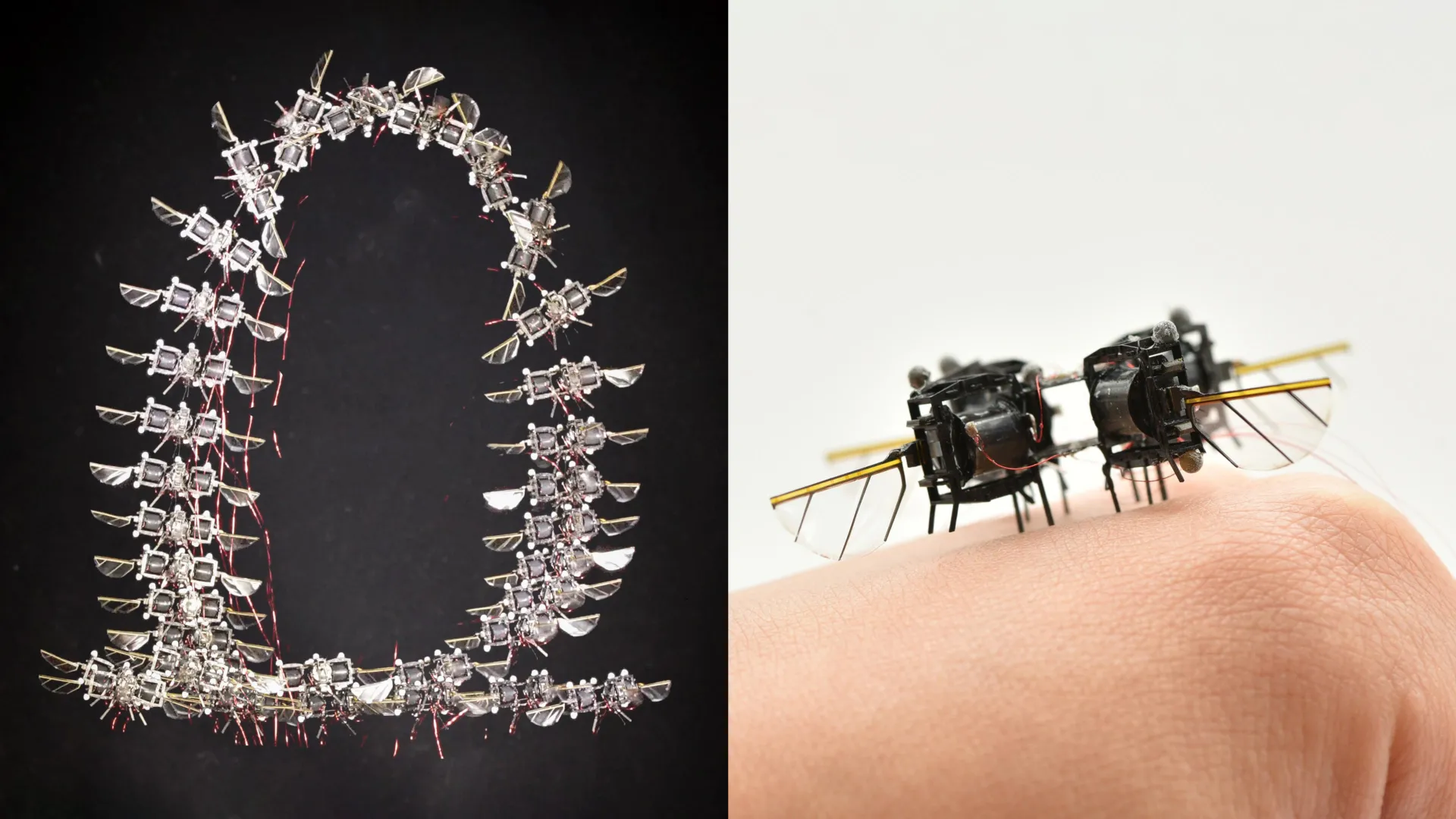
In the aftermath of a catastrophic earthquake, every second is a race against time. Rescuers often face the agonizing limitations of physical size, unable to reach victims trapped in the narrow, unstable fissures of a collapsed building. For years, the dream of deploying swarms of tiny, insect-sized robots to navigate these death traps has remained just out of reach—hampered by the slow, clumsy, and predictable flight paths of current microrobotics.
That narrative shifted dramatically this week with the publication of a landmark study in Science Advances. Researchers at the Massachusetts Institute of Technology (MIT) have unveiled a breakthrough in bioinspired robotics: an AI-driven control system that allows a paperclip-sized robot to mimic the high-speed, high-stakes agility of a real insect. By successfully executing complex aerial maneuvers, including rapid-fire somersaults and precise saccades, the team has bridged the gap between fragile, slow-moving prototypes and the nimble, autonomous machines of the future.
The Genesis of the Micro-Flyer: A Chronological Evolution
The journey to this achievement spans more than five years of rigorous development within MIT’s Soft and Micro Robotics Laboratory, led by Kevin Chen, an associate professor in the Department of Electrical Engineering and Computer Science (EECS).
The Early Days (2018–2021)
Initially, the focus was purely mechanical. The team sought to build a robot that could survive the physical rigors of disaster sites. This led to the creation of an incredibly durable, insect-scale drone—roughly the size of a microcassette—that utilizes soft artificial muscles. Unlike traditional rigid motors, these synthetic muscles contract with extreme speed, allowing for high-frequency wingbeats. However, while the hardware was maturing, the "brain" remained primitive. Early models required painstaking manual tuning by human operators, making complex navigation impossible.
The Integration Phase (2022–2023)
Recognizing that physical durability was only half the battle, Chen partnered with Professor Jonathan P. How, an expert in the Laboratory for Information and Decision Systems (LIDS). The goal was to solve a fundamental paradox: how to process complex, high-speed aerodynamic data in real-time on a machine that has almost zero onboard computational capacity. The collaboration between the Soft and Micro Robotics Lab and the LIDS group proved to be the catalyst for the current success.
The Breakthrough (2024)
By late 2023 and early 2024, the team successfully developed the two-part AI controller. This system allowed the robot to transition from simple hovering to aggressive, acrobatic flight. The recent successful demonstration of the robot completing 10 consecutive somersaults in 11 seconds marked the culmination of this five-year arc, moving the technology from a lab curiosity to a viable platform for field-ready innovation.
Engineering the "Brain": Supporting Data and Methodology
The primary challenge in microrobotics is the "computation-agility trap." To perform an aggressive maneuver, a robot needs to calculate complex fluid dynamics and wind resistance in milliseconds. Usually, this requires a supercomputer; however, the robot is small enough to be carried by a breeze.
To overcome this, the MIT team implemented a two-step "brain":
- The Expert Planner (Model-Predictive Control): This system uses a deep mathematical model to simulate potential flight paths. It is the "planner," responsible for deciding how to execute a flip or a turn while staying within the force and torque limits of the hardware. While highly effective, it is too computationally heavy to run on the fly.
- The Real-Time Policy (Imitation Learning): The researchers used the Expert Planner to "teach" a deep-learning neural network. By observing the expert, the network learned to mimic its decisions. This "policy" is lightweight, fast, and capable of operating in real-time during actual flight, providing the robot with near-instantaneous decision-making capabilities.
The Metrics of Success
The results of this dual-controller architecture are quantifiable and striking:
- Speed Increase: A 447% improvement over previous iterations.
- Acceleration Boost: A 255% increase in acceleration capabilities.
- Stability: Even when subjected to external wind disturbances, the robot maintained a tight variance of only 4 to 5 centimeters from its planned trajectory during its 10-somersault trial.
The Experts Weigh In: Insights from the MIT Team
The collaborative nature of this research highlights the multidisciplinary approach required to solve problems at the micro-scale.
"We want to be able to use these robots in scenarios that more traditional quadcopter robots would have trouble flying into," explains Kevin Chen. "Now, with our bioinspired control framework, the flight performance of our robot is comparable to insects in terms of speed, acceleration, and the pitching angle. This is quite an exciting step toward that future goal."
Jonathan P. How, the Ford Professor of Engineering and co-senior author, emphasizes the symbiotic relationship between the hardware and software. "The hardware advances pushed the controller so there was more we could do on the software side," How notes. "As Kevin’s team demonstrates new capabilities, we demonstrate that we can utilize them. If small errors creep in, and you try to repeat that flip 10 times with those small errors, the robot will just crash. We needed to have robust flight control to reach this level of precision."
The co-lead authors—Yi-Hsuan Hsiao, Andrea Tagliabue, and Owen Matteson—were instrumental in bridging the gap between theoretical AI and physical execution. "This work demonstrates that soft and microrobots, traditionally limited in speed, can now leverage advanced control algorithms to achieve agility approaching that of natural insects," says Hsiao.
Implications: A New Paradigm for Search and Rescue
The successful demonstration of this technology is not merely an academic exercise; it represents a fundamental shift in how we might handle disasters in the future.
Navigation in Restricted Environments
Traditional drones, while efficient in open air, are too large to navigate the tangled, debris-filled environments of a collapsed building. Their rotors are vulnerable, and their flight controllers are designed for wide-open spaces. The MIT robotic insect, by contrast, is designed to navigate the same cluttered, chaotic environments that biological insects thrive in.
The Future of Multi-Modal Locomotion
The research team is already looking toward the next phase: equipping these robots with onboard sensors and cameras. Currently, the robots rely on external motion-capture systems to track their position. By miniaturizing these sensors, the team hopes to enable truly autonomous flight.
"One major goal is to allow them to fly outdoors without depending on a sophisticated external motion capture system," Chen says. Furthermore, the ability to coordinate swarms of these robots—allowing them to communicate with one another to avoid collisions—could lead to a "search net" that covers an entire building in minutes, a task that would take human search-and-rescue teams hours or days.
A Signal of Change
For the broader robotics community, this paper serves as a proof-of-concept that "high-performing" and "computationally efficient" are not mutually exclusive goals. By adopting this two-step control architecture, researchers working on other small-scale machines—from micro-medical devices to environmental monitoring drones—have a new blueprint for success.
As the team looks toward the next five years, the prospect of "robotic swarms" assisting in disaster recovery is no longer a matter of science fiction. It is a matter of scaling the hardware, refining the onboard sensing, and ensuring that these delicate machines can survive the real-world conditions of a disaster zone. With the "brain" problem largely solved, the path to the field is becoming clearer than ever.
This research was supported by the National Science Foundation (NSF), the Office of Naval Research, the Air Force Office of Scientific Research, MathWorks, and the Zakhartchenko Fellowship.
 Reynand Wu
 Ammar Sabilarrohman
 rifanmuazin
