
 By Laily UPN
SAN FRANCISCO — In the sterile glow of late-night screen time, millions of smartphone users routinely experience a quiet, hollow ritual. At 11:47 PM, driven by a nagging sense of dread rather than genuine curiosity, they open an app just to tap a button, feed a digital mascot, or check a streak counter. When the animation flashes green, confirming their streak is saved for another 24 hours, they do not feel joy or triumph. They feel a complex cocktail of relief and quiet self-loathing—the distinct psychological signature of an engineered compulsion loop.
For over a decade, the playbook of modern digital product design has relied on this exact dynamic. Borrowing heavily from behavioral psychology, casinos, and free-to-play mobile gaming, tech companies built empires on extrinsic manipulation. Daily Active Users (DAU), retention curves, push notifications, and streak counters became the gospel of Silicon Valley growth teams.
Yet, as the digital landscape matures, a profound counter-movement is taking shape among designers, product leaders, and digital ethicists. Dubbed "Gamification 2.0," this emerging philosophy poses an uncomfortable question to an industry addicted to metrics: What happens when the metrics are optimized, but the human being on the other end of the screen feels entirely empty?
The Main Facts: The Crisis of Extrinsic Motivation
The core thesis of Gamification 2.0 is deceptively simple: people play games because games are worth playing, not because games award points, guilt-trip them about streaks, or populate leaderboards. Great games create experiences worth having—experiences that foster a sense of capability, creativity, and connection. They respect the player’s intelligence, time, and agency.
In contrast, mainstream corporate "gamification"—badges in project management tools, meaningless points systems in enterprise software, and aggressive streak-shaming in educational apps—frequently treats users like laboratory animals.
Product teams trained in growth hacking and rapid-fire A/B testing have spent years asking the wrong questions:
- Instead of asking: "How do we increase DAU?" the new paradigm asks: "What would make this experience genuinely enjoyable?"
- Instead of asking: "What mechanics can we copy from successful apps?" it asks: "What genre naturally aligns with what our users are trying to accomplish?"
- Instead of asking: "How do we reward engagement?" it asks: "How do we make engagement its own reward?"
This shift requires dismantling decades of bad habits. Companies are beginning to realize that apps built on intrinsic motivation—such as Minecraft, Roblox, or Notion—achieve long-term, self-sustaining loyalty. They don’t trap users with compulsion loops; they provide genuine, lasting value.
Chronology: From Pixelated Fun to Corporate Compulsion Loops
To understand how product design arrived at this ethical crossroads, it is helpful to trace the evolution of interactive engagement over the last half-century.
Phase 1: The Golden Age of Intrinsic Play (1970s–1990s)
Games evolved from 8-bit sprites on arcade cabinets to expansive home console cartridges. The foundational motivation was pure: mastery, discovery, and fun. Players willingly faced immense difficulty—from Super Mario Bros. to The Legend of Zelda—not because an algorithm bribed them with daily login bonuses, but because overcoming the challenge yielded authentic pride.
Phase 2: The Social & Mobile Gold Rush (2000s–2010s)
With the rise of smartphones and social networks, software developers discovered the lucrative potential of variable reward schedules, first studied by psychologist B.F. Skinner. The goal shifted from creating masterpieces of interactive art to capturing human attention. "Gamification" was coined as a buzzword in 2002 by Nick Pelling, and by the 2010s, it had been weaponized. Apps across every sector—from fitness trackers to language learning—began implementing badges, leaderboards, and streak counters to artificially inflate engagement.
Phase 3: The Burnout and the Backlash (Late 2010s–Present)
By the close of the decade, users began experiencing systemic digital fatigue. The constant psychological pressure of notifications, streaks, and artificial urgency bred widespread resentment. Users could articulate a growing sense of being manipulated. Forward-thinking product teams began recognizing that short-term retention spikes driven by guilt were cannibalizing long-term brand trust. The stage was set for Gamification 2.0: a return to respect, dignity, and real psychological value.
Supporting Data & Industry Insights: The Psychology of Mastery vs. Manipulation
To grasp why traditional gamification ultimately alienates users, one must examine the profound psychological difference between fake achievement and real mastery.
Consider the structural difference in how major interactive milestones make users feel:
- The Guitar Hero Effect: Mastering a difficult song gives a player real, transferable rhythm and coordination skills.
- The Portal Phenomenon: Solving a complex physics puzzle yields an electric rush of insight, proving to the player that their logical reasoning is sharp.
- The Dark Souls Test: Defeating a notoriously difficult boss after dozens of failures proves that the player has measurably improved their observation, timing, and resilience.
These experiences leave users feeling capable, proud, and eager to tackle the next genuine challenge.
Conversely, shallow corporate gamification leaves users feeling used. According to internal user-research metrics leaked across various tech sectors over the years, retention driven primarily by streak preservation often correlates with high "churn-and-return" cycles—users who desperately want to quit an app but remain trapped by the fear of losing their arbitrary status symbols.
When an app forces a user to check a counter at midnight just to maintain an unbroken chain of meaningless interactions, it crosses the line from software utility into psychological hostage-taking.
Official Responses and Industry Perspectives
Design philosophers and veteran game developers have grown increasingly vocal about the ethical debt accumulated by the tech industry.
"When you watch someone play a game they genuinely love—not a game they are addicted to, but one they love—you see something remarkable," notes digital product strategist Elena Vance. "They lean forward. They experiment. They laugh when they fail because failure teaches them something. That is the feeling your app should create. Not anxiety about broken streaks."
Product leaders advocating for Gamification 2.0 point out a fundamental flaw in legacy design frameworks: treating human motivation as a single universal algorithm.
- A strategy-game enthusiast does not want chaotic action mechanics.
- A puzzle solver rejects arbitrary RPG grinding.
- A creative sandbox explorer gains nothing from a rigid, linear progression tree.
Yet, legacy gamification treats all users identically, applying the same crude behaviorist tricks across entirely different user personas.
"We are not Pavlov’s dogs," argues veteran UX researcher Marcus Thorne. "Ring the bell, get the food; break your streak, feel the shame. This is entirely beneath the potential of modern software design. Users can feel the difference between an app that respects their intellect and one that treats them like metrics-driven automatons."
Implications: The Standard for Gamification 2.0
As the digital economy looks toward the future, the implications of this shift are profound for product managers, UX designers, and c-suite executives.
1. Redefining Success Metrics
Companies must phase out dashboards that prioritize raw, anxious engagement over sustained utility. The ultimate standard for success must no longer be: How effectively have we trapped users in a compulsion loop?
Instead, it must be: Do our users feel genuinely better, more capable, and more accomplished for having used our app?
2. Radical Empathy and Genre Alignment
Product teams must stop blindly copying features from competitor apps and instead ask: What kind of experience are we creating, and what genre of game does that naturally resemble? By studying the underlying psychology of masterclass games—whether it’s the exploration loops of Breath of the Wild or the collaborative building blocks of Minecraft—developers can craft software that feels naturally rewarding.
3. The Dignity Test
A simple litmus test now circulates among ethical product designers: Would a twelve-year-old nephew—someone who has spent thousands of hours playing expertly crafted, high-standard games—see through this feature immediately? If a gamification feature elicits an eye-roll from a savvy digital native, it is not gamification; it is manipulation wrapped in a game aesthetic.
Conclusion: Designing for Human Potential
The era of cheap behavioral hacks and exploitative dark patterns is drawing to a close. Users are increasingly walking away from apps that treat them like laboratory rats, seeking out platforms that honor their time, intelligence, and dignity.
Gamification 2.0 offers a path forward. It invites creators to remember what it feels like to accomplish something real, to learn something valuable, and to build something they can be proud to show their friends and family without having to excuse manipulative mechanics.
We are humans seeking meaning, mastery, and connection. Our digital tools should reflect that humanity. By designing for genuine value, intrinsic joy, and profound human potential, the tech industry can finally build products that are truly worth playing—and living—with.
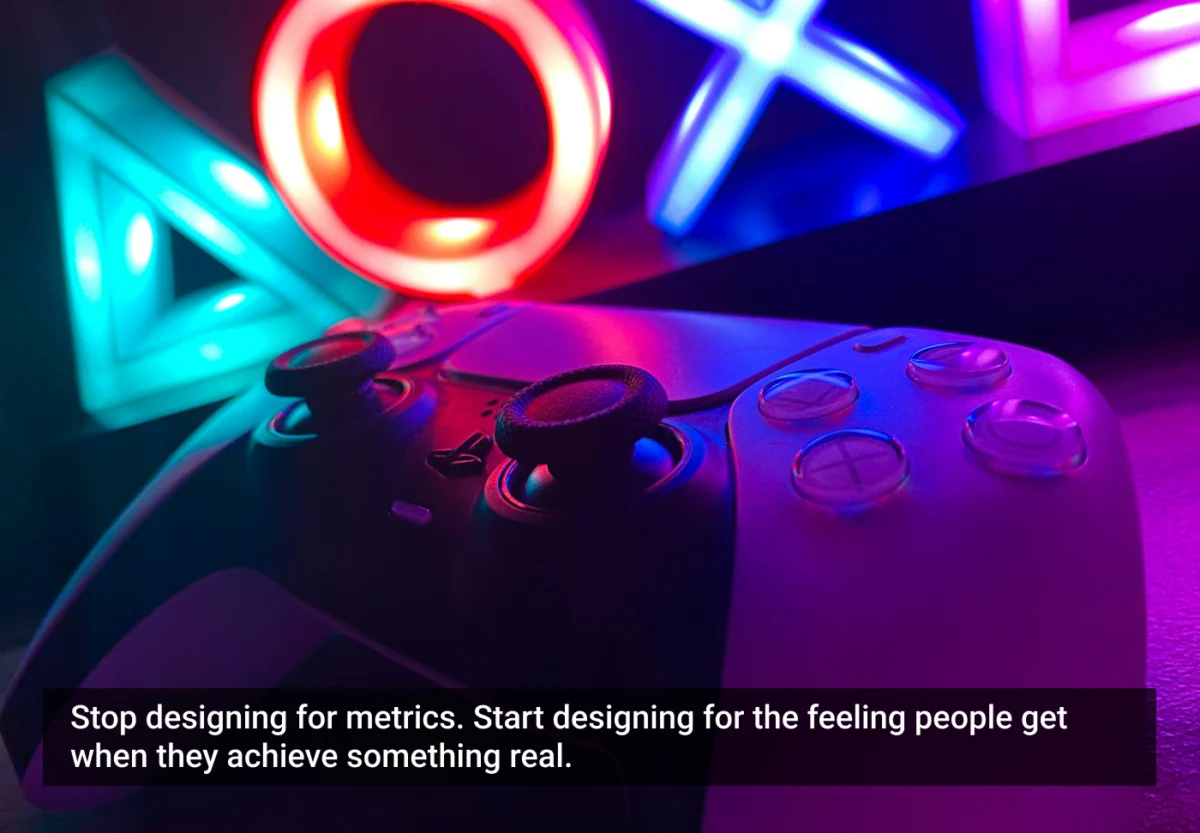
Featured image courtesy of Cash Macanaya via Unsplash.
 Nana Muazin
 Raul Delapena Setiawan
 Suro Senen
