
 By Ammar Sabilarrohman
By the Editorial Desk
Published: May 2026
Main Facts: The Great Disconnect in Modern EdTech
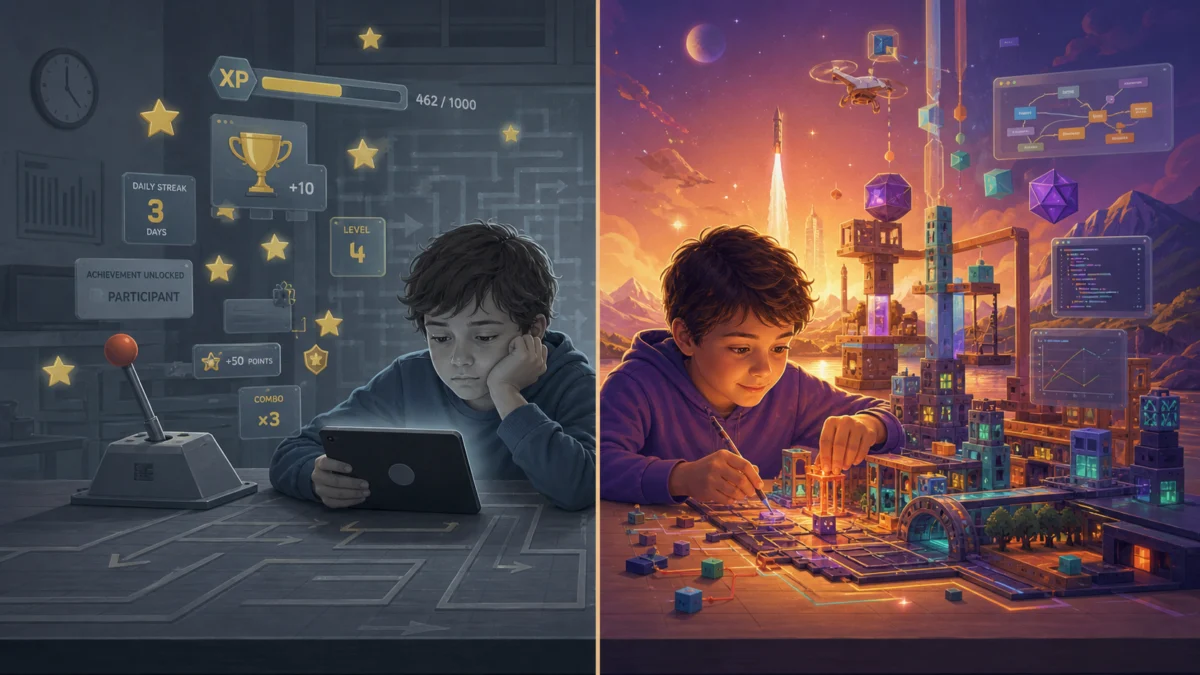
The modern digital classroom faces a profound and widening cultural divide. On one side stand children and teenagers belonging to Generation Z and Generation Alpha—demographics that have grown up navigating intricate sandbox environments, cooperative multiplayer economies, and real-time computational logic. On the other side stand educational software developers and legacy publishing houses attempting to engage these digital natives with what critics have dubbed "shallow gamification": digital worksheets retrofitted with XP bars, cartoon mascots, and meaningless digital badges.
The core conflict is stark: youth consumers, fluent in the complex design language of platforms like Minecraft, Roblox, and Fortnite, immediately recognize surface-level engagement tactics for what they are. Rather than inspiring a love for learning, superficial reward loops often alienate students, triggering an adverse reaction to mechanisms they view as patronizing, transparently manipulative, and ultimately boring.
Chronology: The Evolution of Digital Learning and Play
To understand how the educational technology sector reached this crossroads, it is necessary to examine the timeline of how young people interact with digital media over the last two decades.
- The Early 2010s (The Rise of Simple Gamification): As tablets flooded classrooms, educational software developers began borrowing basic concepts from behavioral psychology and early mobile gaming. The prevailing theory was simple: if a student completes a math problem or a spelling test, rewarding them with a digital star or a point tally will drive motivation.
- The Mid-to-Late 2010s (The Sandbox Explosion): Simultaneously, outside of school, children migrated en masse to user-generated content platforms. Minecraft and Roblox transitioned from niche pastimes into global cultural phenomena. Millions of children learned basic programming, spatial reasoning, and collaborative economics not through formal instruction, but through open-ended play and peer-to-peer coordination.
- The Early 2020s (The Pandemic Acceleration): Remote learning forced schools to adopt digital tools at an unprecedented scale. EdTech investments surged, leading to a flood of capital into "gamified" learning apps. However, production timelines often favored quick deployment of skins and progress bars over deep pedagogical game design.
- The Present Day (The Reckoning): Today’s students possess thousands of hours of collective gaming experience. Having inhabited sophisticated digital universes where actions have meaningful, systemic consequences, they possess a highly refined BS-detector regarding corporate attempts to simulate fun.
Supporting Data: The Anatomy of Bad Gamification
Industry analysts and UX researchers point to three primary structural failures that characterize ineffective educational gamification. These flaws explain why traditional point-and-badge systems consistently underperform when measured against true interactive media.
1. The "Points Equate to Play" Fallacy
Non-gaming developers frequently assume that games are fundamentally reward-delivery systems. In reality, compelling games are sophisticated experiences built on flow states, risk-reward balances, and narrative progression. Awarding 50 experience points for a routine arithmetic drill does not transform a worksheet into a game; it simply places a flashy wrapper around rote memorization.
2. The Patronization Factor
Children as young as eight or nine can readily distinguish between genuine accomplishment and artificial inflation. When an application flashes celebratory animations and dispenses hollow praise for basic task completion, it risks insulting the user’s intelligence. Having mastered complex mechanics in commercial titles, modern youth view these hollow accolades as transparently manipulative.
3. The Absence of Agency and Emergence
True games offer player agency—the ability to experiment, fail productively, and discover novel solutions. Conversely, poorly gamified educational tools are typically linear and prescriptive: complete Task A, receive token, unlock Task B. There is no room for systemic experimentation, reducing the student from an active creator to a passive subject responding to a Skinner box.
Official Responses and Industry Perspectives
The debate over effective educational design has drawn sharp commentary from software engineers, UX designers, and educational psychologists alike.
Dr. Aris Thorne, a cognitive learning specialist focusing on digital environments, notes that the problem is not gamification itself, but the lazy execution of the concept.
"When we slap a leaderboard onto a spelling test, we aren’t utilizing the power of play," Thorne explains. "We are utilizing the mechanics of a slot machine. Children notice this. They have spent years engaging with systems that reward genuine mastery and creativity. When school tools offer them a hollow badge instead, they feel shortchanged."
Meanwhile, developers within the indie game space argue that the EdTech industry suffers from a structural blind spot: a lack of representation from native gamers among decision-makers.
"If you ask a traditional software executive how to make something fun, they look at metrics, retention loops, and badge economies," says Maya Lin, a lead UX designer specializing in interactive learning tools. "They don’t look at player autonomy, narrative immersion, or puzzle design. Until educational software is built by people who deeply understand why games like Portal or Breath of the Wild resonate, we will continue to churn out digital busywork."
Implications: What Developers Must Do to Compete
The implications of this generational shift extend far beyond the classroom; they represent a fundamental reality check for any developer targeting Gen Z and Gen Alpha users.
1. Recognizing the Real Competition
For productivity and educational apps, the primary competitor is no longer rival software within the same category. The direct competitor is Roblox. Because young users compare every digital experience against the high-production, high-agency environments they frequent in their leisure time, sub-par applications will be summarily rejected, gamed for minimum requirements, or abandoned at the earliest opportunity.
2. Shifting from Surface Mechanics to Genre Alignment
Experts suggest abandoning the vague directive of "How do we gamify this?" and replacing it with structural genre analysis:
- Language Learning: Should it mirror a Role-Playing Game (RPG) focusing on capability building and unlocking new communicative abilities?
- Fitness Tracking: Should it adopt management simulation principles (optimizing performance systems) or action-game mechanics (immediate, satisfying execution)?
- Mathematics: Can it function as a puzzle game centered on elegant problem-solving rather than linear drills?
3. Embracing the Tool Status
Perhaps the most liberating realization for developers is that not everything needs to be a game. If an application functions primarily as a productivity tool or a structural utility, developers should focus on making that tool exceptionally well-designed, fast, and respectful of the user’s intelligence.
As the digital landscape matures, the era of tricking students into learning through superficial XP bars is drawing to a close. For the next generation of learners, if an experience claims to be a game, it had better live up to the name—otherwise, they will simply log off and find something real.
 Nana Muazin
 Raul Delapena Setiawan
 Suro Senen
