
 By Basiran
In the realm of classical physics, objects are defined by their interactions. To influence a particle, one must exert a force—a push, a pull, or an electromagnetic interaction—directly upon it. However, the quantum world has long challenged this intuitive reality with phenomena that seem to defy the "common sense" of the macroscopic world. Among the most enigmatic of these is the Aharonov-Bohm effect, a 1959 prediction that suggested a charged particle could be profoundly affected by a magnetic field it never actually enters.
Now, a team of researchers at the University of Oxford has successfully recreated this phenomenon within a hybrid quantum computer, moving beyond mere observation into the realm of active simulation. By using a sophisticated arrangement of trapped ions, the team demonstrated how an "invisible" magnetic influence can bring a particle’s quantum motion to a complete standstill. This breakthrough, published in the journal Nature Physics, marks a significant milestone in our ability to model the fundamental building blocks of the universe.
The Aharonov-Bohm Effect: A Ghostly Influence
To understand the significance of the Oxford experiment, one must first grasp the strange nature of the Aharonov-Bohm effect. Proposed by Yakir Aharonov and David Bohm in 1959, the effect suggests that a charged particle traveling around a region containing magnetic flux will experience a measurable shift in its quantum state, even if the particle’s trajectory never intersects the magnetic field itself.
In the classical world, this is akin to a car being steered by a road it never touches. In quantum mechanics, however, it is governed by the "quantum phase"—a mathematical property of a particle’s wave function that dictates how different possible paths interfere with one another. When a particle moves around a magnetic flux, the flux alters this phase. When the particle’s path splits and recombines, the phase shift causes the two paths to interfere destructively, effectively canceling each other out. This interference is not a direct force in the Newtonian sense, but rather a subtle modification of the particle’s wave-like probability distribution.
For decades, this effect has served as a touchstone for the weirdness of quantum mechanics, proving that particles respond to the underlying structure of fields in ways that transcend direct contact.
Chronology of a Quantum Leap
The journey toward this latest realization began in 2022, when Dr. Sebastian Saner and Dr. Oana Bazavan, working alongside their colleagues at the University of Oxford and Dr. Alejandro Bermudez of the Instituto de Física Teórica in Madrid, sought to push the boundaries of "lattice gauge theories."
Lattice gauge theories are the mathematical frameworks physicists use to describe the interactions between matter and the fundamental forces of nature. They model space as a grid, where matter resides at points and fields exist along the connections (or "links") between those points. While these theories are essential to particle physics, they are notoriously difficult to calculate. As the complexity of a system grows, the mathematical burden on conventional supercomputers becomes insurmountable.
The Experimental Timeline
- Early 2022: The Oxford team begins conceptualizing a hybrid quantum system capable of simulating lattice gauge theories, moving away from purely classical simulation toward direct quantum mimicry.
- Mid-2022: The researchers develop a design utilizing trapped ions. By using the internal states of the ions as qubits and their collective vibrations as oscillators, they create a functional analog for the matter-field interaction.
- Late 2022 – 2023: The team builds a "minimal" loop—a single unit of a lattice gauge theory—to test if the Aharonov-Bohm effect could be observed in a system where the magnetic flux is not a static background, but a dynamic participant.
- 2024: The experiment successfully demonstrates the total suppression of quantum tunneling in the presence of the simulated flux, confirming the effect and validating the hybrid quantum approach.
The Anatomy of the Experiment: Qubits and Oscillators
The Oxford team’s success hinged on their ability to create a "hybrid" system. They utilized trapped ions—electrically charged atoms suspended by electromagnetic fields—to perform dual roles.
The first component involved the internal energy levels of these ions, which served as qubits. These qubits functioned as the gauge fields, representing the "grid" that connects points of matter. The second component utilized the quantum oscillators—the actual physical vibrations of these trapped ions—to represent the matter itself.
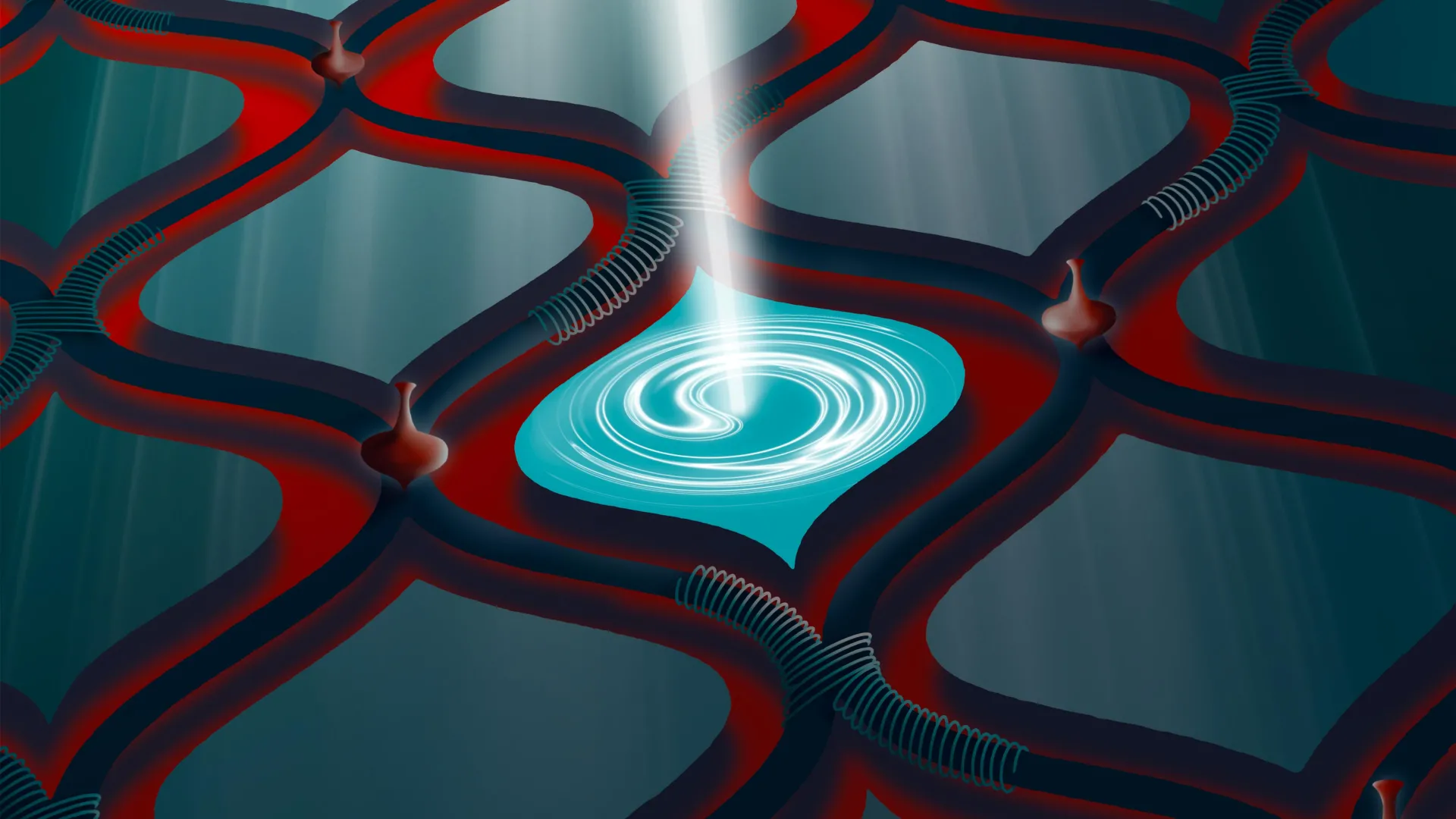
By linking these two, the researchers created a closed loop. Two oscillators represented matter located at two distinct points, while two qubits represented the fields connecting them. This configuration allowed them to simulate the interaction between a moving particle and a magnetic flux.
Crucially, the team chose to encode the magnetic flux directly into the qubits. This was a departure from standard practice, where magnetic fields are usually treated as fixed, external conditions. By making the flux a "dynamical" part of the system, the researchers allowed the matter and the field to evolve together. As Dr. Sebastian Saner noted, this move transformed the experiment from a passive observation into a study of active, reciprocal quantum dynamics.
Official Responses and Scientific Context
The publication of the Oxford results in Nature Physics was accompanied by a study from the University of Maryland, led by Professor Norbert Linke. While the two teams worked independently, their synchronized publication highlights the growing momentum in the field of hybrid quantum simulation.
The Maryland team focused on the Yukawa potential—a mathematical description of the forces that hold atomic nuclei together. Together, these two studies provide a compelling argument for the utility of hybrid quantum computers. By combining different quantum components, researchers are no longer restricted to rigid, idealized models; they can build systems that mirror the actual, messy, and interactive nature of the quantum universe.
In their formal response, the researchers emphasized that the "stopping" of the particle was not a result of a physical barrier or a force field being turned on, but rather the manifestation of destructive wave interference. "It was the realization of a truly quantum effect," the team noted in their report. "We didn’t just model the Aharonov-Bohm effect; we allowed the field and the particle to dance together as part of the same dynamical system."
Implications: The Future of Quantum Simulation
The implications of the Oxford experiment extend far beyond the laboratory. By successfully simulating a lattice gauge theory with dynamical fields, the researchers have opened the door to studying phenomena that were previously considered "computationally unreachable."
High-Energy Physics and Beyond
In the study of high-energy physics, scientists are often thwarted by the "sign problem"—a mathematical hurdle that arises when trying to calculate the behavior of fermions (particles like electrons and quarks) using classical computers. Quantum simulators, by their very nature, bypass this problem by existing in the same physical state as the system they are meant to replicate.
Designing New Materials
The ability to simulate the interplay between matter and fields has immediate applications in condensed matter physics. Scientists are currently looking for ways to create materials with exotic properties, such as high-temperature superconductors or topological insulators. These materials are governed by the same lattice gauge principles that the Oxford team simulated. As our ability to control these hybrid quantum systems grows, we may be able to "engineer" new states of matter by simulating them first on a quantum computer.
A Paradigm Shift in Computing
Perhaps the most profound implication is the shift in how we conceive of "calculation." For decades, the goal has been to build computers that calculate faster. The Oxford experiment suggests a different path: building computers that "emulate" better. By constructing a system that follows the same underlying rules as the universe, we don’t need to calculate the outcome—we simply observe it.
As Dr. Saner and his team look toward the future, the goal is to scale this minimal loop into larger, more complex lattices. If a two-qubit, two-oscillator system can demonstrate the Aharonov-Bohm effect, a hundred-qubit system could potentially unlock secrets of the vacuum, the nature of dark matter, or the early conditions of the Big Bang.
In conclusion, the Oxford team has not merely recreated an old experiment; they have demonstrated a new methodology for scientific discovery. By embracing the counterintuitive, "ghostly" nature of the quantum world, they have shown that the best way to understand the universe is to build a smaller version of it and watch it play out in real-time. The invisible hand of the magnetic field may not touch the particle, but thanks to this new generation of quantum simulators, it is finally within our grasp to understand how it pulls the strings.
 Reynand Wu
 Ammar Sabilarrohman
 rifanmuazin
