
 By Asro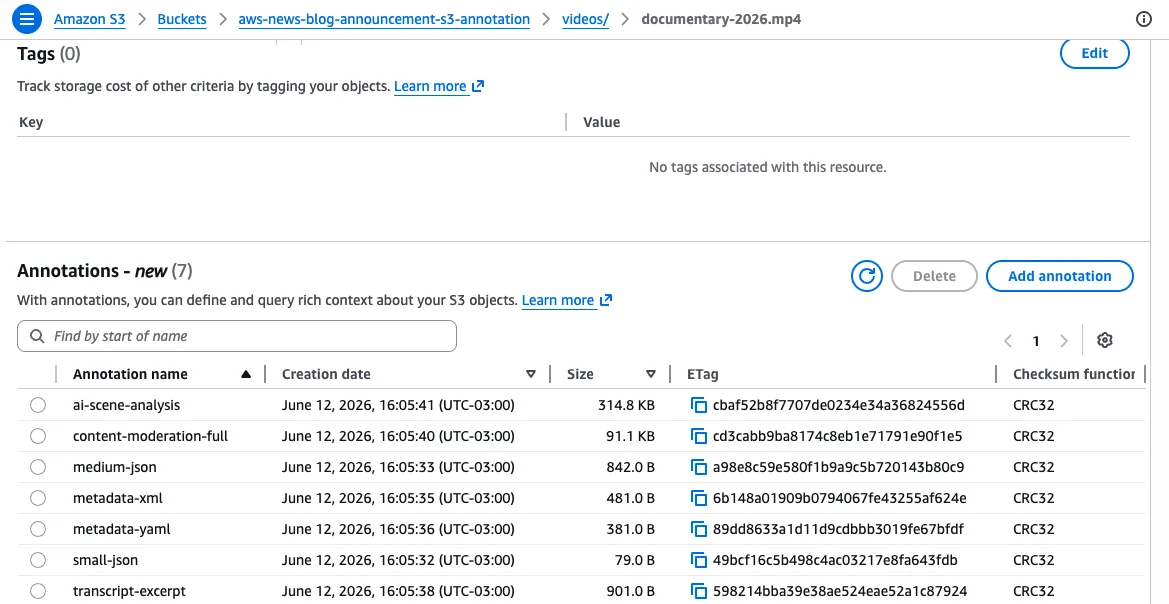
In a landmark development for cloud-native data management, Amazon Web Services (AWS) has unveiled a powerful new capability for Amazon Simple Storage Service (S3) known as "Annotations." This feature marks a significant departure from traditional metadata limitations, allowing organizations to attach massive amounts of rich, mutable, and queryable business context directly to their S3 objects. As enterprises grapple with the explosion of data required to train and maintain AI models, S3 Annotations provide the connective tissue between raw data and the autonomous workflows that depend on it.
The Core Innovation: Moving Beyond Static Metadata
For nearly two decades, Amazon S3 has served as the bedrock of the data lake, providing highly durable and scalable object storage. However, as the complexity of data usage has evolved—moving from simple storage to active participation in AI and machine learning pipelines—the limitations of existing metadata models became increasingly apparent.
Previously, developers were restricted to system-defined metadata (like object size or creation time), immutable user-defined metadata (limited to 2 KB), or object tags (ideal for lifecycle management but restrictive in size and structure). These tools, while effective for basic operations, forced developers to maintain "sidecar" databases or external metadata stores to keep track of deeper, more meaningful business context.
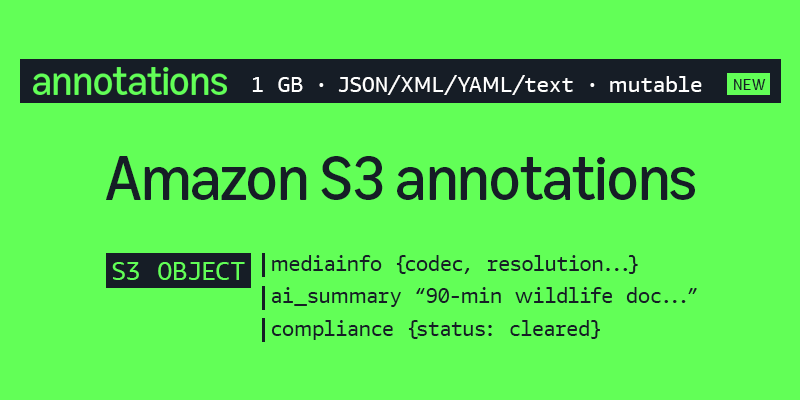
S3 Annotations fundamentally redefine this landscape. Users can now attach up to 1,000 distinct annotations to a single object, with each annotation capable of holding up to 1 MB of data. This translates to an impressive 1 GB of metadata per object. Crucially, these annotations support flexible, industry-standard formats such as JSON, XML, YAML, and plain text. By enabling this, AWS has essentially moved the "context" inside the "container," ensuring that business logic travels seamlessly with the data it describes.
A Chronology of the Development
The journey toward this release reflects the broader shift in how modern enterprises handle "Data Gravity."
- The Pre-AI Era: S3 was primarily used for cold storage or static delivery. Metadata was minimal, focusing on file integrity and billing.
- The Rise of Data Lakes: As S3 became the center of big data analytics, the demand for better searchability grew. This led to the introduction of S3 Inventory and object tagging, which helped organizations manage costs and security policies.
- The AI/Agentic Shift: With the emergence of Large Language Models (LLMs) and autonomous AI agents, the need for "machine-understandable" metadata became critical. AI agents needed to know what was in a file—its sentiment, its legal status, or its technical specifications—without needing to open the file itself.
- The Launch of Annotations: Announced today, S3 Annotations serve as the bridge for these agentic workflows, providing a standardized, queryable interface that removes the friction of maintaining external indexing systems.
Supporting Data: Why Scale Matters
The engineering behind S3 Annotations is designed to solve the "Metadata Bottleneck." In traditional architectures, querying metadata stored in an external database often leads to latency issues and synchronization errors. If a file is deleted but the database is not updated, the system enters an inconsistent state.
S3 Annotations eliminate this by binding the lifecycle of the metadata to the lifecycle of the object. When an object is moved, copied, or deleted, its annotations move or are purged automatically.
Comparison of Metadata Capabilities
| Capability | Max Size | Mutable? | Best For |
|---|---|---|---|
| System Metadata | Fixed | No | File properties, storage class |
| User Metadata | 2 KB | No | Small, static key-value pairs |
| Object Tags | 10 tags (128/256 bytes) | Yes | Lifecycle, Access Control |
| Annotations | 1 GB (1,000 x 1 MB) | Yes | Rich context, AI prompts, specs |
This structural leap is not just about size; it is about accessibility. By integrating with Amazon Athena and Apache Iceberg, S3 effectively turns your entire object storage into a relational-style database. Because these annotations flow into managed tables, developers can execute complex SQL queries to identify specific subsets of data—for instance, "Find all video files with a resolution higher than 4K that contain an ‘Approved’ content rating"—without performing a single expensive S3 GET request on the actual objects.
Implications for Industry and AI Workflows
The implications for developers and data scientists are profound, particularly in media, healthcare, and finance.
Media and Entertainment
A media house storing millions of raw video clips can now attach technical specifications (codecs, frame rates) and AI-generated summaries directly to the file. When a producer searches for "outdoor scenes in daylight," the AI agent queries the annotation table, identifies the correct file paths, and retrieves only the necessary footage, saving thousands of dollars in egress and compute costs.

Healthcare and Compliance
In highly regulated environments, data privacy is paramount. Organizations can attach compliance metadata (e.g., PII status, HIPAA consent flags) directly to an object. If an audit is required, the organization can query the entire repository using Athena to generate a compliance report, rather than manually scanning petabytes of data.
The Rise of Agentic Workflows
Perhaps the most significant implication is for AI agents. By utilizing the S3 Tables MCP (Model Context Protocol) server, AI agents can now "reason" over the S3 environment. They can use natural language to navigate the data lake. An agent can be instructed to "clean up all outdated experimental data from 2023," and it will look at the annotation table, identify the relevant objects, and execute the deletion, all within a single unified ecosystem.
Technical Implementation and Integration
Getting started with S3 Annotations is designed to be developer-friendly, leveraging existing AWS CLI and API structures. The process involves two primary steps:
- Attaching Metadata: Using the
PutObjectAnnotationAPI, users push their structured data (JSON/YAML) to an object. This is a non-destructive process, meaning it does not require rewriting the original file. - Enabling Queryability: By toggling the
AnnotationTableConfigurationin the S3 console or via API, users instruct AWS to start indexing these annotations into an Apache Iceberg table.
The system is built for performance. While the primary object remains in its original storage class (Standard, Glacier, etc.), the annotation itself is managed by the metadata service. Even if an object is moved to Glacier Deep Archive, the annotations remain queryable via Athena, ensuring that metadata is always "hot" even when the data is "cold."
Official Perspectives and Future Outlook
While specific quotes from leadership remain under embargo, industry analysts have long signaled that this move was the "missing piece" in the AWS storage puzzle. By offloading the complexity of metadata indexing to the service provider, AWS is effectively reducing the "Total Cost of Ownership" (TCO) for data-heavy applications.
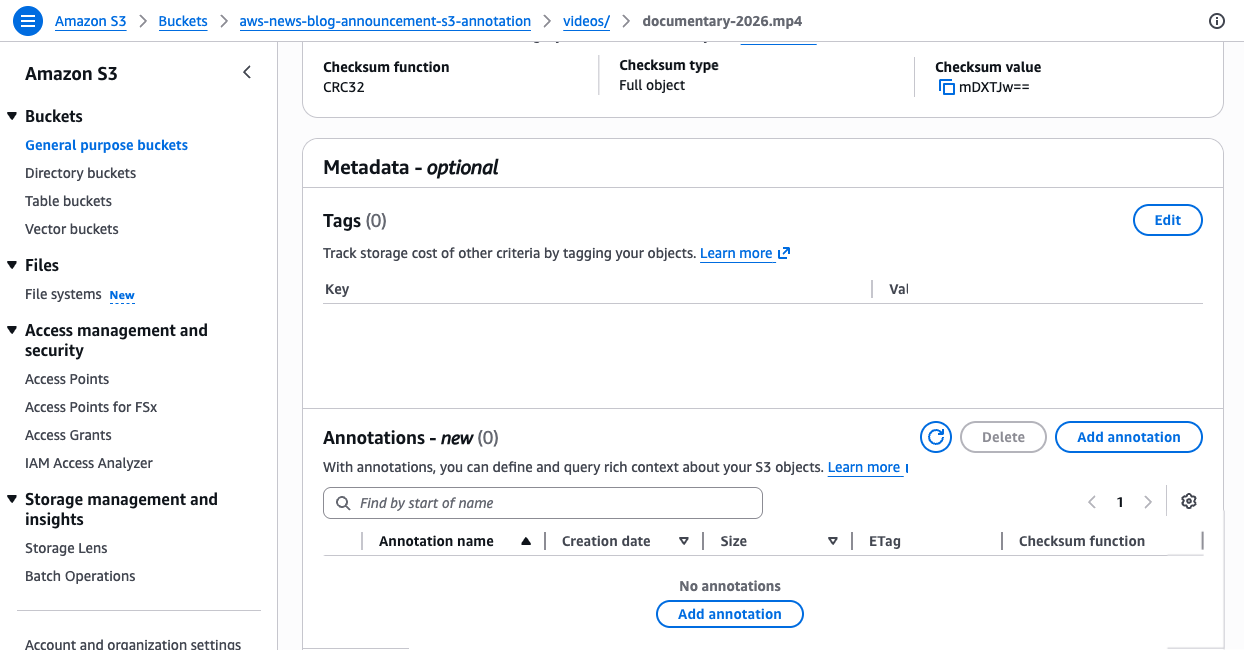
The shift toward "Metadata-as-a-Service" suggests a future where the distinction between a database and a file system becomes increasingly blurred. For the average developer, this means fewer lines of code dedicated to plumbing and more time focused on building value-added AI applications.
Conclusion: A New Standard for Data Management
The introduction of S3 Annotations is more than a feature update; it is a fundamental shift in how cloud architecture treats information. By providing a scalable, mutable, and queryable way to tag objects, AWS has cleared the path for a new generation of autonomous, data-driven applications.
As we move deeper into an era defined by AI, the ability to curate, organize, and understand data at scale will be the defining competitive advantage for enterprises. With S3 Annotations, AWS has provided the tools to ensure that as your data grows, your ability to understand it grows right alongside it. Whether you are managing a massive media archive or training a foundation model, the era of "dark data"—data that is stored but cannot be easily queried or understood—is rapidly coming to an end.
For those ready to integrate this into their workflows, the AWS documentation and S3 console are now updated to support the full lifecycle of annotation management. It is, without question, the most significant update to the S3 user experience in the last decade.
 Neng Nana
  Suro Senen
  Lina Hope