
 By Dwi Wanna
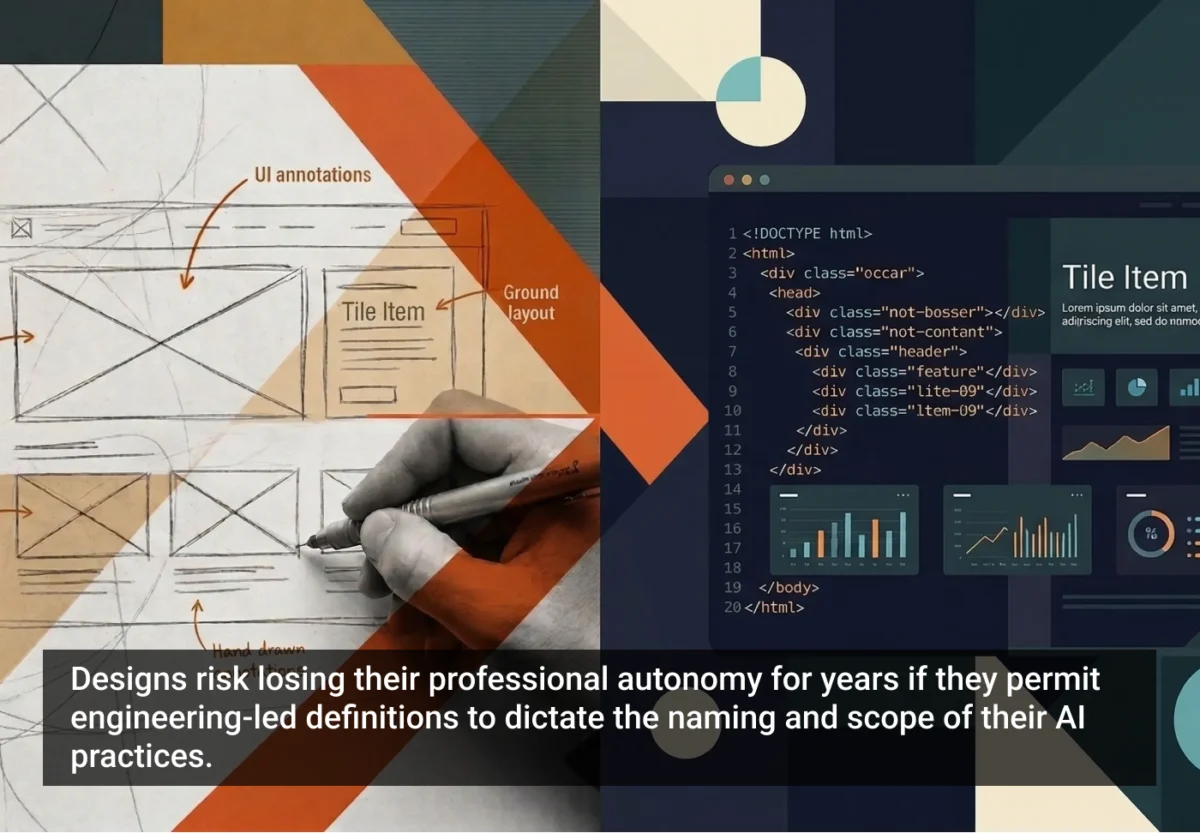
Main Facts: The Great Nomenclature Divide in AI Design
The modern design ecosystem is undergoing a quiet but consequential fracture. At the heart of this division is a battle for vocabulary, authority, and professional identity. As artificial intelligence embeds itself deeper into the daily workflows of creative professionals, a linguistic parasite has taken root: “vibe coding.”
Originally coined by AI researcher Andrej Karpathy in early 2025 to describe a specific, low-accountability software generation behavior—where users loosely describe an idea, accept raw model output, and forego deep understanding of the code—the term has rapidly metastasized. It has bled over from engineering culture into the broader design community, where it is increasingly used to dismiss or mischaracterize serious, highly intentional AI-assisted design work.
Designers who passively accept the "vibe coding" label are inadvertently relinquishing the authorship of their own practice. The core conflict is not about whether designers use artificial intelligence—adoption rates are near-universal. Rather, the fundamental divide is about where authority lives in the process.
While passive generation lets the AI drive decisions through loose prompting and marginal adjustments, serious design leadership relies on directed generation, where human judgment comes first, and the machine responds to curated intent. If the design industry fails to reject imprecise jargon imported from adjacent technical fields, it risks pre-shaping how clients, employers, and junior practitioners value, understand, and hire for design craftsmanship before a proper taxonomy can take root.
Chronology: From Novelty to Normalization and the Battle for Definitions
To understand how the design industry arrived at this linguistic crossroads, it is necessary to trace the rapid evolution of generative tools over the past several years.
Phase 1: The Novelty and the Black Box (2022–2023)
When early text-to-image and generative layout tools first emerged, they were treated as novelties or parlor tricks. The workflow was strictly output-driven: users threw prompts into chat interfaces, rolled the dice on randomized pixel outputs, and manually stitched together whatever usable fragments emerged. During this era, serendipity ruled, and accountability was low. Engineers and technologists dominated the discourse, establishing a vocabulary centered on prompts, parameters, and stochastic generation.
Phase 2: The Integration and the Vocabulary Vacuum (2024–Early 2025)
As AI tools matured into production-grade environments, the nature of the work changed dramatically. Advanced models began processing not just text, but complex visual references, spatial constraints, and underlying logic structures. However, because the design community was slow to formalize its own operational lexicon, a vocabulary vacuum formed. Engineering culture eagerly filled the void, importing terms like "vibe coding" to describe generative workflows across the board. This blanket terminology conflated low-accountability experimentation with rigorous, reference-guided design systems.
Phase 3: The Inflection Point of Directed Generation (Present Day)
We are currently in the "late-early" stage of AI-assisted design. The technology is thoroughly normalized, but the methodologies are actively crystallizing. Leading practitioners are systematically pushing back against inherited shorthand. A growing movement of design leaders is drawing a hard line between stochastic output generation and intentional, human-led composition, setting the stage for a new era of non-deterministic design standards.
Supporting Data & Conceptual Frameworks: The Mechanics of Directed Generation
To grasp why the "vibe coding" label fails to capture advanced creative work, one must examine the mechanics of how intentional designers actually collaborate with modern AI systems.
1. Judgment Before Generation
In a traditional or low-accountability workflow, the AI acts as the primary driver:
- Prompt: The user types a loose textual description.
- Acceptance: The model generates an output.
- Tuning: Minor manual adjustments are made at the margins, followed by immediate shipping.
In contrast, directed generation inverts this hierarchy:
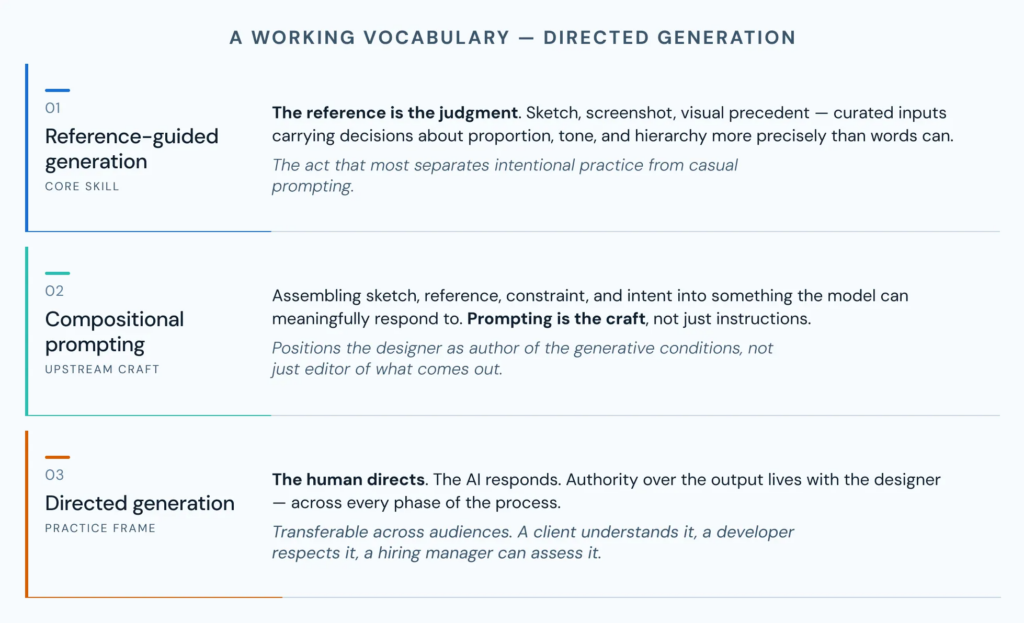
- Curated Input: The process starts with a deliberate reference—a hand-drawn sketch, a precise screenshot, a mood board, or a visual precedent.
- Encoded Intent: This reference carries implicit decisions regarding proportion, typographic hierarchy, pacing, and emotional tone. It communicates intent with a fidelity that paragraphs of text could never achieve.
- Guarded Response: The machine responds strictly to the designer’s structured parameters, ensuring the human remains the absolute author of the core concept.
2. Deterministic vs. Non-Deterministic Design Systems
This methodological shift transforms how design systems scale:
| Dimension | Traditional Model (Deterministic) | Directed Generation (Non-Deterministic) |
|---|---|---|
| Artifact Status | Fixed, documented, and strictly replicated components. | Dynamic, relational patterns that adapt contextually. |
| Consistency Method | Achieved through rigid component replication. | Achieved through shared spatial, typographic, and behavioral logic. |
| Designer’s Role | Specifying every single instance manually. | Defining the boundary conditions for reliable, high-quality emergence. |
| Primary Value | Predictable, pixel-perfect execution. | Rapid cross-surface pattern interpretation and scaled cohesion. |
By moving judgment from the individual pixel to the pattern level, non-deterministic design systems allow machines to interpret—rather than blindly copy—core design primitives. This paves the way for agentic delivery, where autonomous systems generate coherent multi-platform outputs without ever diluting the original authoring intent.
Official Perspectives and Industry Reactions
The debate over what to call AI-assisted design has sparked intense discussion across UX networks, design systems collectives, and leadership forums.
Industry veterans point to historical precedent to emphasize the weight of nomenclature. When User Experience (UX) first emerged as a distinct discipline, early practitioners who actively named and defined their practices—staking claims on terms like interaction design and information architecture—successfully shaped how corporate boards and clients valued their work for decades. Conversely, fields that allowed adjacent technical disciplines to define their boundaries spent years clawing back lost professional ground.
The Pragmatist Objection: Does Terminology Really Matter?
A common counter-argument from pragmatic designers suggests that nomenclature is academic vanity: Clients care about the shipped product, not the semantic taxonomy used to build it.
However, design leaders argue that this perspective ignores crucial high-stakes environments:
- The Portfolio Review: Where hiring managers evaluate whether a candidate understands foundational craft versus automated shortcut-taking.
- The Client Kickoff: Where designers must justify premium rates by articulating a rigorous, repeatable, and sophisticated process.
- The Mentorship Dynamic: Where junior designers look to senior practitioners to understand what professional rigor looks like in an AI-saturated world.
To help bridge this vocabulary gap, forward-thinking practitioners have proposed alternative handles for the practice—not as rigid dogmas, but as cognitive anchors:
- Directed Generation: Highlighting human authority over machine output.
- Reference-Guided Practice: Emphasizing the primacy of curated visual and conceptual inputs.
- Compositional Prompting: Reframing prompts as architectural building blocks rather than conversational guesses.
Implications: Reclaiming Craft in the Age of Intelligent Tools
The ultimate implication of the "vibe coding" debate extends far beyond semantics; it touches on the survival of design as an autonomous, high-value profession.
A Hybrid Future for Production Environments
Embracing directed generation does not mean abandoning traditional workflows entirely. Mature production environments require a hybrid mindset. For final, mission-critical UI components where risk tolerances are near zero, deterministic outputs—fixed, documented, and exhaustively reviewed patterns—remain essential.
However, for rapid concept exploration, generative wireframing, and cross-device adaptation, non-deterministic approaches deliver outsized returns. A mature design practice recognizes when to shift between these gears, utilizing the right tool for the specific phase of the product lifecycle.
The Imperative of Professional Self-Definition
George Orwell famously observed that the slovenliness of language makes it easier to harbor foolish thoughts. The inverse is equally true: precise language enables precise thinking.
When external industries—driven by engineering velocity or media sensationalism—impose a sloppy label like "vibe coding" onto design leadership, they flatten a complex, deeply intentional discipline into a passive game of chance.
Designers stand at a critical historical inflection point. If they wish to retain their authority, command executive respect, and mentor the next generation of creators, they must stop inheriting other industries’ shorthand. By naming their own methods, owning their descriptions, and anchoring AI tools firmly within a framework of human judgment, designers can ensure that they remain the authors of their own medium.
 Nana Muazin
 Raul Delapena Setiawan
 Suro Senen
