
 By Asep Darmawan
SAN FRANCISCO — In the rapidly evolving landscape of modern product development, a silent vocabulary war is being waged. At stake is not merely what we call our tools, but who holds the ultimate authorship over creative work. As artificial intelligence fundamentally reshapes the day-to-day realities of digital creation, a growing cohort of design leaders is pushing back against imported jargon—specifically, the casual, ubiquitous adoption of terms like "vibe coding."
According to industry veterans, designers who comfortably embrace or acquiesce to this passive label are inadvertently relinquishing control over their own narrative. Originally coined in early 2025 by prominent technologist Andrej Karpathy to describe a low-accountability, high-level approach to software generation, "vibe coding" was never meant to define rigorous design leadership. Yet, as the term bleeds into creative workflows, it threatens to relegate the deliberate, highly intentional acts of modern design into mere button-pushing and happy accidents.
For an industry striving to cement its strategic value in boardrooms and client kickoffs, the stakes could not be higher. If designers fail to name their own practices, engineering cultures and shorthand journalism will gladly do it for them—shaping how the profession is hired, valued, and understood for a generation.
Main Facts: The Great Divide in AI-Assisted Design
The fundamental tension in contemporary design is no longer about whether teams are using AI—nearly all of them are, at least nominally. Instead, the real chasm lies in where authority lives within the workflow.
- The Passive Paradigm ("Vibe Coding"): In this approach, generation drives the decisions. A user types a loose prompt, accepts whatever the model outputs, and makes minor, surface-level tweaks before shipping. Accountability is low, and the understanding of the underlying mechanics is often superficial.
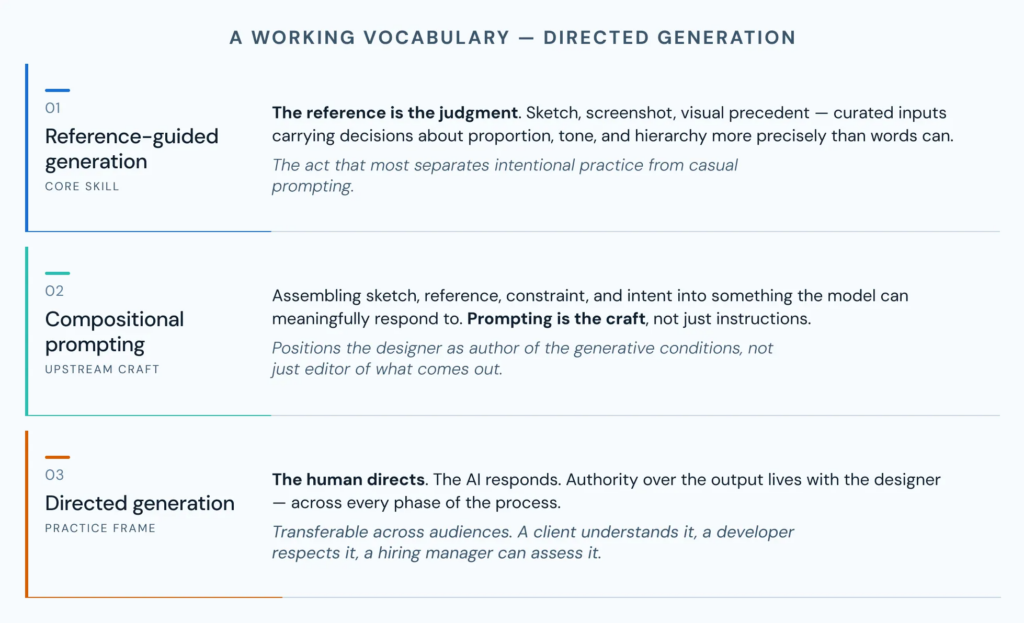
- The Active Paradigm (Directed Generation): Conversely, sophisticated design workflows are built on a foundation where human judgment arrives first. The AI responds to the designer, functioning as a high-fidelity engine executing heavily curated visual and structural intent.
This latter model—often referred to variously as directed generation, reference-guided practice, or compositional prompting—is fundamentally changing how digital products are scaled. Rather than specifying every single pixel or static component, designers are moving upstream. They are crafting the fundamental primitives, establishing strict behavioral constraints, and allowing AI systems to interpret and recompose design patterns dynamically across surfaces those systems have never seen before.
Chronology: How Engineering Jargon Colonized Design
To understand how the design community arrived at this conceptual crossroads, one must examine the timeline of how AI-assisted tooling entered the mainstream.
Phase 1: The Code-First Explosion (Late 2023 – 2024)
As foundational large language models and early multimodal generators matured, the first wave of workflow innovation emerged primarily from engineering environments. Tools were built by developers, for developers. Naturally, the nomenclature reflected software engineering paradigms—focusing on speed, script generation, and rapid iteration.
Phase 2: The Coining of "Vibe Coding" (Early 2025)
In early 2025, Andrej Karpathy popularized the term "vibe coding" to accurately depict a specific, liberating engineering behavior: loosely describing a desired outcome to an AI model and accepting the resulting code blocks with minimal oversight. It was an honest descriptor for a specific developer state of mind.
Phase 3: Conceptual Creep and Term Migration (Mid 2025 – Present)
Almost immediately, the term migrated outside of engineering constraints into product design, UI/UX, and creative direction. Observers began labeling advanced human-machine design collaborations as "vibe coding." Designers who curated complex visual references, set intricate systemic boundaries, and managed non-deterministic outputs suddenly found their meticulous craft lumped in with low-accountability prompt engineering.
This linguistic colonization, experts warn, threatens to strip designers of their professional authority by framing them as supervisors rather than authors.
Supporting Data and Technical Realities: Non-Deterministic Design
The shift from traditional, deterministic design systems to non-deterministic, AI-assisted methodologies represents a massive technical evolution.
In the traditional model, design patterns are treated as fixed artifacts. They are meticulously defined in Figma, thoroughly documented in Confluence, and applied via strict replication. While this guarantees exact pixel consistency, flexibility is frequently sacrificed, causing design systems to buckle under the weight of hyper-customized multi-platform environments.
Directed generation upends this bottleneck. When a machine understands a design pattern abstractly—comprehending spatial, typographic, and behavioral relationships rather than just flat visual assets—the pattern behaves dynamically.
[Curated Reference/Input]
       ↓ (Carries proportion, tone, hierarchy)
[Directed Generation Engine]
       ↓ (Interprets intent abstractly)
[Contextual Multi-Surface Output] (Adapts fluidly across devices without breaking core grammar)
Industry analysts note that this shift yields outsized returns in specific areas:
- Rapid Concept Exploration: Testing dozens of structural layouts in minutes while maintaining underlying design integrity.
- Generative Wireframing: Moving from abstract product requirements to interactive, structurally sound prototypes at unprecedented velocity.
- Cross-Surface Pattern Interpretation: Scaling design tokens and behaviors seamlessly from mobile apps to spatial computing interfaces.
Crucially, this does not mean traditional design systems are dead. Mature organizations are adopting a hybrid approach, recognizing that different phases of product development carry drastically different risk tolerances. Production-ready components still require manual specification, review, and locking, while generative exploration thrives on non-deterministic freedom.
Official Responses and Industry Perspectives
Design leaders across the globe are sounding the alarm, urging their peers to take ownership of their professional vocabulary before external definitions become permanent industry standards.
"Language matters because it travels," notes one prominent design systems architect. "George Orwell observed that the slovenliness of language makes it easier to have foolish thoughts—and the reverse is also true: precise language makes precise thinking possible. When an imprecise term colonizes an emerging practice, it doesn’t just misdescribe the work; it pre-shapes how the work gets understood, hired, and valued."
Historically, the design profession has walked this path before. During the advent of User Experience (UX) design as a formal discipline, practitioners who actively named and bounded their skill sets—differentiating interaction design from information architecture—successfully shaped how corporate America valued their contributions for decades. Conversely, practitioners who allowed adjacent engineering and business fields to define them spent years recovering lost ground.
Corporate buyers and clients do not typically see the complex orchestration of prompts, constraints, and visual references behind the scenes; they see the final output. However, during critical moments—such as portfolio reviews, client kickoffs defending agency retainers, and mentorship conversations with junior designers—having precise, confident, and self-authored language is the ultimate mark of professional maturity.
Implications: The Road Ahead to Agentic Delivery
As the technology matures, the natural endpoint of directed generation is agentic delivery.
In this next era, AI systems will not merely respond reactively to individual design prompts. Instead, they will operate as autonomous agents carrying design intent forward across massive enterprise scales. The designer’s role will permanently evolve from a tactical pixel-pusher into a systemic author—writing the cultural and visual grammar that autonomous systems will speak fluently.
For this future to be recognized and valued properly, the design community must shed borrowed shorthand like "vibe coding" and embrace a lexicon that honors human judgment, rigorous craft, and strategic intentionality. Whether the industry settles on directed generation, reference-guided practice, or compositional prompting, the mandate is clear: own the practice, and you will own the description.
 Nana Muazin
 Raul Delapena Setiawan
 Suro Senen
