
 By Basiran
By: UXM Editorial Team
Series: Invisible Machines
Main Facts: The Current State of Enterprise AI
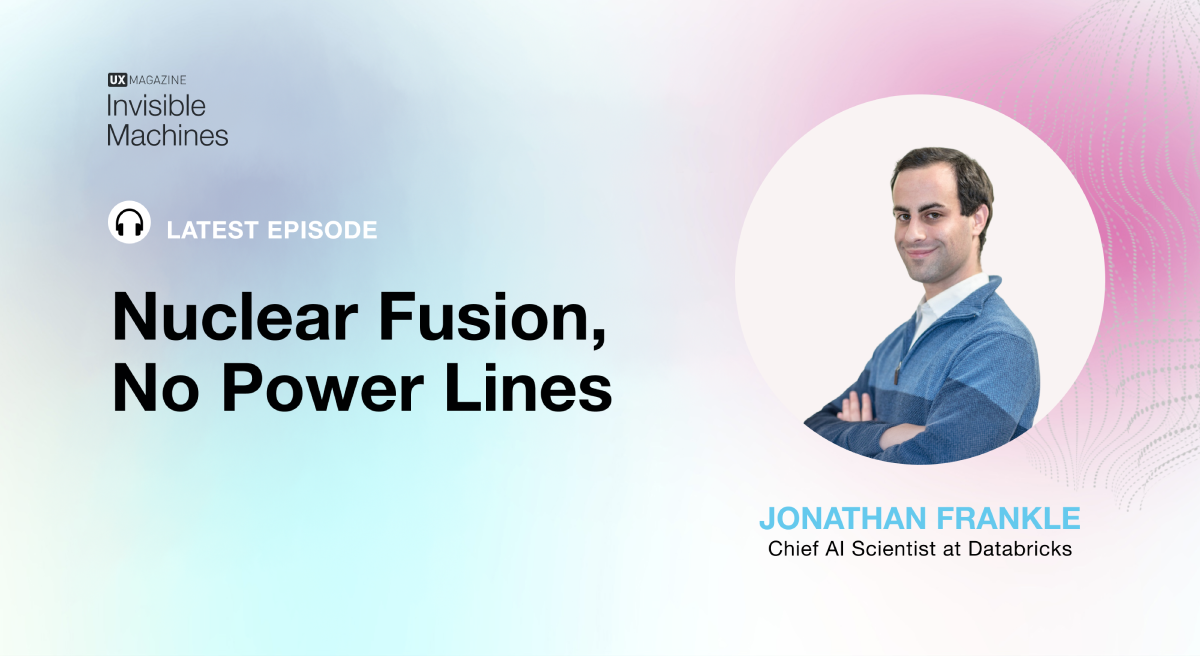
Three years after defining the nascent "data mixology" of early large language models, Databricks Chief AI Scientist Jonathan Frankle has returned with a stark diagnosis of the artificial intelligence landscape. In a wide-ranging discussion on the Invisible Machines podcast, Frankle encapsulated the current era of generative AI with a potent metaphor: "We built nuclear fusion. We forgot the power lines."
The core thesis of Frankle’s argument is that the raw, foundational intelligence of modern language models represents an unprecedented technological breakthrough—akin to capturing the limitless power of nuclear fusion. However, the software engineering ecosystem, enterprise tooling, and infrastructure required to channel that power safely and predictably into human intent remain dangerously underdeveloped.
Key takeaways from Frankle’s diagnostic include:
- The Infrastructure Gap: While foundation models (LLMs) have achieved breathtaking leaps in capability, the industry lacks a standardized "grid"—the specification frameworks, rigorous testing disciplines, and composable tools required to reliably translate human intent into reliable model behavior.
- The "Fortran Era" of Prompt Engineering: Current development paradigms rely heavily on natural language prompts and ad-hoc tinkering. Frankle argues that the industry is trapped in the "Fortran days" of computing, desperately needing a modern equivalent to Java, Pascal, or C to make programming systems human-comprehensible and verifiable.
- The Illusion of Benchmarks: Academic benchmarks (such as HellaSwag) offer little to no predictive value regarding what enterprise users or ChatGPT consumers actually need, shifting the burden entirely onto bespoke evaluation sets and strict requirements engineering.
- Prompts as Parameters: Natural language prompting is functionally equivalent to training; developers are simply optimizing natural-language parameters rather than neural network weights.
Chronology: From the Cupcake Ladder to Enterprise Scale
To understand Frankle’s current perspective, it is instructive to trace his evolution from his days as MosaicML’s chief scientist to his current leadership role at Databricks.
2023: The Data Mixology Era
When Frankle first appeared on Invisible Machines in 2023, the generative AI gold rush was in its infancy. OpenAI’s GPT-4 had recently debuted, and enterprises were scrambling to understand how to train, fine-tune, and deploy models.
During that episode, Frankle used culinary analogies to demystify pre-training:
- The Betty Crocker Problem: Training a language model was likened to baking a massive cake where the recipe (data curation) mattered infinitely more than just turning up the heat (compute).
- The Mini-Cupcake Ladder: Frankle advocated for iterative, small-scale experiments—baking mini-cupcakes before committing millions of dollars to bake the metaphorical wedding cake.
- The Benchmark Illusion: He warned against relying on academic leaderboards, arguing that high scores on standardized tests rarely correlated with real-world utility.
2024–2025: Scaling Up and Hitting the Wall
Following MosaicML’s acquisition by Databricks, Frankle’s purview expanded from working with a handful of frontier research teams to advising thousands of global enterprises. The challenges shifted rapidly from how to build models to how to deploy them without breaking business-critical processes.
In his recent return to the podcast, Frankle noted that while the underlying science of context windows, retrieval-augmented generation (RAG), and multimodal inputs has evolved, the core operational bottlenecks remain identical—only the stakes are infinitely higher. Enterprises are no longer experimenting with toy chatbots; they are attempting to wire multi-billion-parameter engines directly into their core workflows.
Supporting Data & Technical Analysis: The Engineering Reality
The discussion on Invisible Machines systematically dismantled several prevailing myths surrounding modern AI architecture, grounding the conversation in rigorous software engineering principles.
Context Windows vs. Retrieval Quality
The industry-wide obsession with expanding context windows—pushing models from 4,000 tokens to millions of tokens—is often marketed as the death of fine-tuning and retrieval-augmented generation (RAG). Frankle poured cold water on this narrative.
"Test it. Climb the ladder," Frankle advised. While stuffing entire codebases or million-token documents into a single prompt window works remarkably well for specific tasks, it frequently degrades performance in others. As context windows expand, models must navigate a dense forest of distractors. Imperfect relevance judgments, combined with the reality that large models are not omniscient, mean that dumping unvetted data into a context window often introduces noise rather than clarity.
"The garbage-in-garbage-out lesson from mixology still holds," Frankle noted. Whether corrupted data enters through pre-training corpora, sloppy RAG pipelines, or bloated prompt-stuffing, the output quality remains tethered to the quality of the input.
The Missing Software Engineering Discipline
In traditional software development, systems are governed by strict engineering doctrines:
- Specification: Formal definitions of what a program is supposed to do.
- Editable Representation: Source code that can be modified predictably line-by-line.
- Verification: Unit tests, integration tests, and regression suites that mathematically or logically prove the software behaves as intended.
In modern AI development, these guardrails are largely absent. Enterprises routinely deploy probabilistic models where a single altered word in a prompt can trigger cascading logic failures. Automated specification tools exist, but Frankle finds most of them inadequate, noting that the difficult work of translating human intent into testable requirements must happen long before a model is ever invoked.
Official Perspectives & Industry Implications
The conversation between Frankle, host Robb, and co-participant Josh touched heavily on the philosophical and practical implications for organizations navigating the trillion-parameter wilderness.
The Rise of LLM Optimization (LLMO)
One of the most profound secondary effects of the generative AI boom is the fundamental shift in how information is published and consumed on the internet. Content is no longer authored solely for human readers or deterministic search engine crawlers (SEO); it is actively ingested as training signal—directly or indirectly—for the next generation of foundational models and autonomous agents.
Frankle predicts the emergence of a robust cottage industry dubbed LLM Optimization (LLMO). Strategic enterprises will soon treat public and internal documentation with the same rigor previously reserved for brand guidelines:
- Curated Canonical Facts: Separating stable, verified truth from tentative draft content or historical archives.
- Sanitized Internal Knowledge: Avoiding the catastrophic mistake of dumping decades of unverified internal documents—complete with outdated policies and documented errors—into an enterprise RAG system, which effectively teaches an agent to manufacture falsehoods at scale.
"Ideally, we would separate knowledge from reasoning and plug fresh brand guidelines into a faithful reasoner," Frankle observed. However, he cautioned that the industry is still far from achieving that clean architectural split.
Natural Language as Source Code
Another critical reframe explored in the episode is the status of natural-language prompting. When operators interact with platforms like Claude or GPT-4, they are not merely "using" software; they are actively programming. They have simply substituted high-level natural language for traditional programming syntax, optimizing human-language parameters rather than binary weights.
This creates a fascinating friction point within product design. As low-code/no-code platforms allow non-technical users to build sophisticated agentic workflows using plain English, developers still scramble for visual back-ends and rigorous version control to verify what those prompts actually accomplished.
Conclusion: The Mindset of the Pragmatic Scientist
Frankle’s enduring impact on the AI community stems less from theoretical breakthroughs—such as his celebrated work on the "lottery ticket hypothesis"—and more from his uncompromisingly pragmatic value system.
He continues to measure his professional success not by academic citation counts or breathless media declarations of "AGI by next Tuesday," but by real-world impact and rigorous experiment design. Long before his breakthroughs in machine learning, Frankle authored a pre-PhD report on police use of facial recognition technology that directly influenced public policy and law.
That same institutional skepticism and demand for empirical proof now inform his warnings to the enterprise world. As organizations race to harness the transformative power of generative AI, Frankle’s message serves as both a warning and a roadmap: stop obsessing over raw model capacity, and start building the engineering power lines required to make intelligence safe, predictable, and useful.
For further exploration, you can access the Ideation Hub or read the complete Full Episode Transcript.
 Nana Muazin
 Raul Delapena Setiawan
 Suro Senen
