
 By Raul Delapena Setiawan
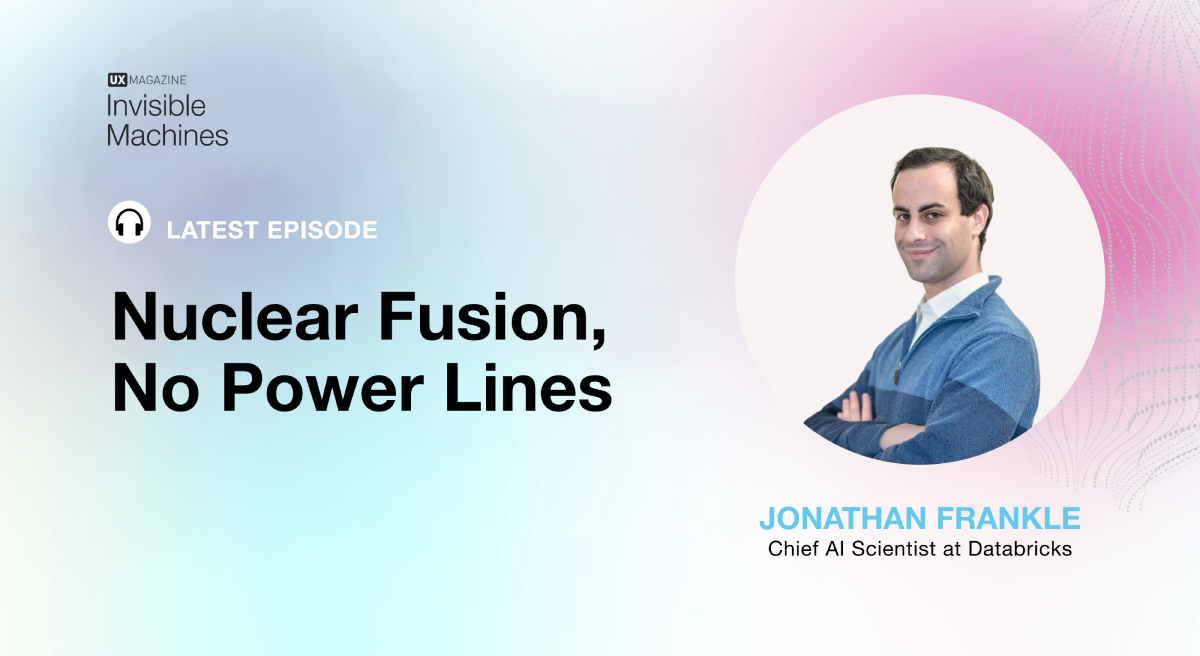
Three years after introducing the tech world to "data mixology," Databricks Chief AI Scientist Jonathan Frankle returns with a sobering diagnosis: We have successfully engineered nuclear fusion-grade intelligence, but we completely forgot to build the power lines.
Main Facts
The artificial intelligence landscape has reached an unprecedented technological milestone: raw computational intelligence that rivals human reasoning. Yet, according to Jonathan Frankle, Chief AI Scientist at Databricks, the industry is suffering from a massive structural disconnect.
During a recent appearance on the Invisible Machines podcast, Frankle revisited a core metaphor that defines the current state of generative AI. Three years after he first appeared on the program as MosaicML’s chief scientist to discuss "data mixology"—the nuanced art of curating training data for large language models (LLMs)—he returns with a sharper, more urgent diagnosis.
The central thesis of Frankle’s argument is stark: The tech industry has successfully built nuclear fusion-grade intelligence, but we have failed to construct the power lines.
In practical terms, this means we possess an extraordinary, albeit expensive and imperfect, source of raw cognitive power. However, what the industry entirely lacks is a reliable "grid." This grid encompasses the foundational layers of modern software engineering: rigorous specification, testing discipline, composable tools, and user-facing applications that reliably connect raw machine capability to ordinary human intent.
Frankle pulls no punches regarding the state of AI tooling. "We’re in the Fortran days," he says. "We really need to invent Java. Or Pascal. Or C. Anything that gives practitioners a human-comprehensible way to describe what they want, edit it predictably, and verify that the system did it."
Key takeaways from Frankle’s industry assessment include:
- The Software Crisis: AI lacks mature equivalents to traditional software engineering disciplines such as unit tests, integration tests, and regression testing.
- Prompts as Parameters: Interacting with models via natural language means users are inadvertently engaged in training—optimizing natural-language parameters instead of raw neural network weights.
- The Illusion of Benchmarks: Public leaderboards and academic benchmarks like HellaSwag offer almost no predictive value regarding what real-world users or enterprise applications actually need.
- The Content Curation Imperative: Enterprises are carelessly dumping massive, unvetted document repositories into RAG (Retrieval-Augmented Generation) pipelines, effectively manufacturing falsehoods at scale.
Chronology
To understand how the AI industry arrived at this infrastructure crisis, it is helpful to trace the evolution of Jonathan Frankle’s public commentary and the rapid scaling of foundational models over the past several years.
The 2023 Baseline: The Data Mixology Era
Three years ago, Frankle sat down with Invisible Machines as the chief scientist of MosaicML. At the time, the industry was grappling with the "Betty Crocker problem" of training language models. Frankle popularized the concept of "data mixology"—emphasizing that baking a massive language model is akin to baking a cake; you have to test the mini-cupcake ladder before you commit to baking the final product.
During that 2023 conversation, Frankle cautioned against blindly trusting academic benchmarks. He argued that developers needed to focus intensely on data quality, curation, and incremental experimentation. Shortly after, MosaicML was acquired by Databricks, scaling Frankle’s pragmatic, measurement-first philosophy from a nimble startup to a corporate giant serving over 12,000 enterprise clients.
The Push for Infinite Context and Multimodality (2023–2024)
As the generative AI boom accelerated, the industry became obsessed with expanding context windows. Researchers chased the fantasy that developers would never need to fine-tune a model again; instead, they could simply dump millions of tokens of documents directly into a massive prompt window.
Simultaneously, the race toward multimodality took center stage. Because images and videos consume massive quantities of tokens, the demand for expansive context windows skyrocketed. However, foundational bottlenecks persisted. As Frankle pointed out then—and reiterates now—the fundamental law of data processing remains unchanged: garbage in, garbage out.
The 2025 Reality Check: The Infrastructure Gap
Today, Frankle returns to the podcasting microphone with a unified theory of AI’s current growing pains. While foundation models have grown exponentially larger and more capable, the tooling used to manage, specify, and verify them remains stuck in an ad-hoc, experimental phase. The conversation has shifted from "Can we build a smarter model?" to "How do we safely wire this massive source of power into human civilization without blowing the circuit breakers?"
Supporting Data
The widening chasm between raw AI capability and enterprise application readiness is supported by shifting trends in enterprise software adoption, data management, and developer workflows.
- The Enterprise RAG Trap: Enterprises attempting to implement Retrieval-Augmented Generation frequently experience degraded performance as they feed larger context windows into models. Rather than improving accuracy, stuffing million-token windows with unvetted corporate archives often introduces distractor tokens, conflicting corporate policies, and unverified historical artifacts, causing models to hallucinate with high confidence.
- The Evaluation Deficit: Despite the proliferation of automated evaluation tools, the vast majority of software engineering teams admit they lack standardized methods for translating human business intent into testable, programmatic requirements before selecting or fine-tuning a model.
- The Shift to Databricks Scale: Moving from MosaicML’s startup environment to Databricks exposed Frankle’s methodologies to thousands of enterprise organizations. This broad vantage point revealed a universal truth: companies are struggling less with model intelligence and vastly more with data hygiene, version control, and deterministic output verification.
- Historical Precedents in Computing: Computing history demonstrates a clear trajectory from raw, unmanageable power to structured abstraction. Just as early computing required the transition from raw machine code and assembly languages to high-level languages like Fortran, C, and Java, the current agentic AI era desperately requires high-level specification languages that allow humans to program systems deterministically.
Official Responses
Industry leaders, software architects, and enterprise strategists have responded to Frankle’s infrastructure diagnostic with a mixture of validation and deep introspection.
The Practitioner’s Dilemma
Platform developers, such as Josh of OneReach.ai, have voiced frustrations that mirror Frankle’s warnings. While building advanced natural-language skills on modern agent platforms, developers frequently find themselves craving visual back-ends and deterministic debugging tools to verify what actually landed in the model’s execution path.
As podcast co-host Robb noted, developers often find themselves building yet another graphical user interface whose sole purpose is to construct a written natural-language prompt. This phenomenon represents a classic Marshall McLuhan loop in product form: old media (traditional software UI) wrapped entirely inside new media (generative AI prompts).
The Databricks Perspective
From his vantage point at Databricks, Frankle emphasizes that the solution to the "power line" problem is not waiting for artificial general intelligence (AGI) to magically solve human intent. Instead, it requires rolling up our sleeves and building the boring, unglamorous plumbing of software engineering.
Frankle continues to measure his professional ethos not merely by academic citations or breakthrough theoretical papers—such as his famous pre-PhD work on the "lottery ticket hypothesis"—but by practical impact. He frequently points to his early undergraduate research on police use of facial recognition, which directly influenced public policy, as his true north. That same value system informs his current crusade against AI hype: less obsession with "AGI tomorrow," and far more focus on meticulous experiment design and dependable system engineering today.
Implications
The realization that artificial intelligence has achieved nuclear fusion-grade intelligence without the accompanying electrical grid carries profound implications for software developers, enterprise leaders, content creators, and the future digital economy.
1. The Birth of LLM Optimization (LLMO)
Just as Search Engine Optimization (SEO) emerged to help human-centric websites navigate Google’s algorithms, a new cottage industry is rapidly forming around LLM Optimization. Static FAQ pages, curated canonical corporate facts, and the deliberate separation of stable, verified truth from tentative draft internal content are becoming paramount enterprise strategies. Organizations that fail to curate their internal data repositories before exposing them to AI agents will find themselves manufacturing corporate falsehoods at scale.
2. The Return of Software Engineering Rigor
The honeymoon phase of treating large language models as magical black boxes is drawing to a close. To cross the chasm into mission-critical enterprise applications, the tech industry must invent rigorous equivalents to unit testing, regression testing, and deterministic specification for AI systems. Until developers possess human-comprehensible ways to describe, edit, and verify what an AI model is supposed to do, organizations will continue to operate inside a fog of trillion-parameter uncertainty.
3. Separating Knowledge from Reasoning
The ultimate architectural goal for enterprise AI remains the clean separation of dynamic knowledge repositories from deterministic reasoning engines. Ideally, companies should be able to plug fresh, verified brand guidelines into a faithful, unyielding reasoner without risking hallucinations or prompt injection vulnerabilities. As Frankle notes, the industry is still remarkably far from achieving this clean split. Until that architecture matures, businesses must navigate the delicate balance between unleashing the raw, transformative power of generative AI and managing the structural absence of safe, reliable power lines.
 Nana Muazin
 Suro Senen
