
 By Reynand Wu
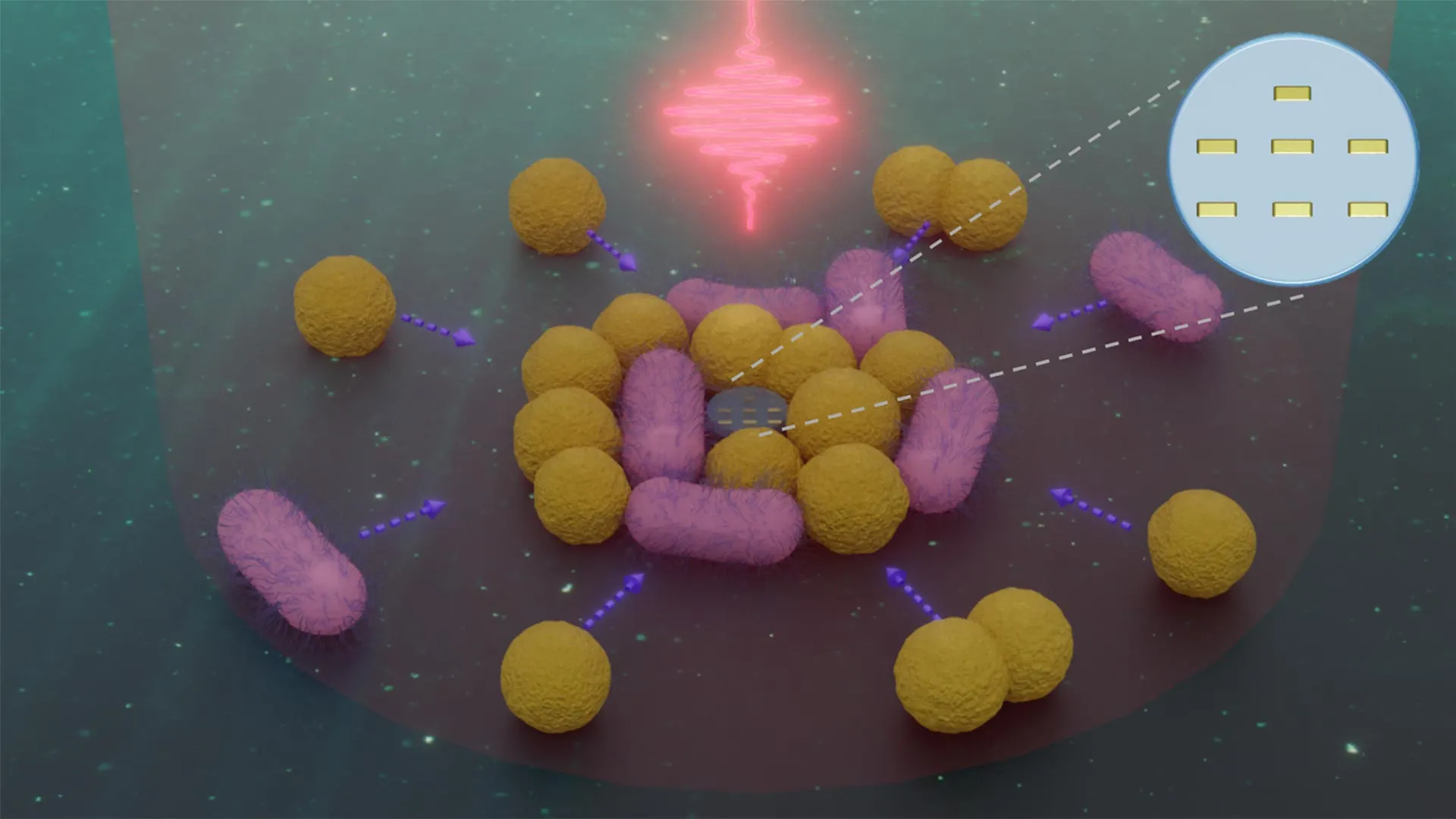
For decades, the field of nanotechnology has been haunted by a singular, persistent challenge: how to interact with the world of the incredibly small without destroying the very objects we seek to manipulate. While our macroscopic world allows for the use of tweezers, robotic arms, and complex machinery, the microbial realm—home to individual cells and bacteria—operates under entirely different physical laws. In this environment, surface tension and viscosity dominate, and conventional mechanical tools are far too clumsy to make an impact.
However, a breakthrough from the Julius-Maximilians-Universität Würzburg (JMU) has brought science significantly closer to the long-held dream of direct, precise interaction with the microscopic world. A research team, led by Professor Bert Hecht, has unveiled a new class of light-powered nanorobots. These machines, measuring less than one micrometer in diameter—approximately 50 times smaller than a single human hair—are capable of navigating fluid environments to capture, transport, and deposit individual bacteria with surgical precision.
The Mechanical Revolution: Main Facts of the Breakthrough
The core innovation behind the JMU project lies in how these robots are powered and steered. At the nanometer scale, traditional battery-powered motors or internal combustion engines are physically impossible due to the constraints of mass and energy density. To overcome this, the JMU team utilized the fundamental physics of light.
The robots are essentially "microdrones" equipped with plasmonic nanoantennas. These structures act as both the engine and the rudder. When specific wavelengths of light hit these antennas, they absorb and re-emit the photons in a controlled direction. This process generates a recoil force—an effect analogous to the kickback experienced when a bullet is fired from a rifle. Because these microdrones possess such negligible mass, this seemingly infinitesimal recoil force translates into significant acceleration and velocity.
By integrating nanoscale antenna wires, the researchers have created a steering mechanism that is both elegant and efficient. These wires align themselves with the polarization of the incoming light. By modulating the polarization of the light source, the operator can dictate the robot’s orientation, effectively "steering" it through a fluid medium while simultaneously propelling it forward via photon recoil.
A Chronological Perspective: From Theory to Micro-Cleaning
The journey to these sub-micrometer robots did not happen overnight. It represents the culmination of years of iterative engineering in photonics and nanotechnology.
The Foundation (Early 2010s)
Early research in plasmonics focused on the interaction between light and metallic nanostructures. Scientists observed that light could exert forces on nanoparticles, but the challenge remained in translating that observation into a directed, controllable "vehicle."
The Prototype Phase (2015–2020)
Researchers at JMU began exploring the use of photon recoil as a viable propulsion method. Initial iterations were larger and required complex external setups to move even a few microns. The goal was to miniaturize the propulsion system without losing the necessary thrust-to-weight ratio.
The Breakthrough (2023–2024)
In the most recent study, the team achieved the critical milestone of producing devices smaller than one micrometer. By simplifying the antenna architecture, they managed to maintain the propulsion and steering capabilities while significantly reducing the footprint of the robot. This reduction in size was the "unlocking" factor that allowed the robots to operate effectively within the microbial domain.
Supporting Data: Efficiency and Maneuverability
The performance metrics of these nanorobots are particularly striking when compared to the chaotic nature of the microscopic environment. In fluid dynamics at this scale, Brownian motion—the random movement of particles suspended in a fluid—usually makes precise positioning a nightmare.
- Size Constraints: At less than 1,000 nanometers, these robots are smaller than many common bacteria (such as E. coli), allowing them to navigate through dense microbial colonies without causing unnecessary disturbance.
- Maneuverability: The robots exhibit the ability to execute high-speed, 90-degree turns. This agility allows them to scan wide areas of a sample rapidly, which is essential for identifying and capturing targets.
- Payload Capacity: One of the most significant findings is the robots’ ability to maintain speed and control even while transporting "substantial numbers" of bacteria. While the added mass of a bacterial cluster does induce a measurable decrease in speed, the propulsion system remains stable enough to continue its mission.
- Energy Efficiency: Because the propulsion is derived from the very light used to observe the robots, the system is exceptionally efficient. There is no need for onboard chemical fuel or internal energy storage, which is the primary failure point for most other proposed nanorobotic designs.
Official Perspectives: Shaping the Microscopic World
The research team, led by Professor Bert Hecht and experimental lead Jin Qin, views this development as a paradigm shift in how we approach microbiology.
"In essence, we have built a light-driven nanorobot that can track down and collect bacteria," says Jin Qin. "By simplifying the design, we reached a size at which these robots can operate directly in the microbial world—almost like microscopic cleaning devices."
The term "microscopic cleaner" is not merely metaphorical. The robots have demonstrated a functional ability to gather bacteria from one environment and relocate them to specific, pre-determined coordinates. This ability to "clean" or "sort" samples has immediate implications for lab-on-a-chip diagnostics and environmental sampling.
Professor Hecht emphasizes the broader philosophical and scientific impact of the study: "This is a striking example of how light can be used not only to observe the microscopic world, but also to actively shape it. The idea of tiny robotic cleaners may sound futuristic, but we are already demonstrating the physical principles that make it possible."
Future Implications: Beyond the Petri Dish
The implications of the JMU breakthrough are vast, extending far beyond the immediate success of moving bacteria.
Biomedical Research and Diagnostics
In clinical settings, the ability to isolate specific bacteria or cells from a complex sample is the "Holy Grail." Current methods, such as flow cytometry, are effective but often require large, expensive, and stationary equipment. A swarm of light-driven nanorobots could theoretically operate within a microfluidic device, performing the same task with higher precision and at a fraction of the cost.
Targeted Drug Delivery
While the current robots are designed for external manipulation in liquid, the physical principles could eventually be adapted for in vivo applications. Imagine a fleet of nanorobots directed by external infrared light to target specific clusters of pathogens or localized tissue damage within the body. While this remains a distant goal, the validation of photon recoil as a reliable, non-toxic propulsion method is a vital step toward that reality.
Materials Science and Manufacturing
At the microscopic scale, the assembly of materials is incredibly difficult. These nanorobots could be deployed to act as "molecular bricklayers," assembling complex microscopic components by transporting building blocks—such as individual molecules or nanoparticles—to specific locations. This would enable the creation of new materials with properties currently unattainable through conventional manufacturing.
Environmental Cleanup
The concept of "cleaning" environments could eventually be applied to real-world water testing. By using light-powered drones to concentrate contaminants or harmful bacteria in a water sample, scientists could achieve detection limits that are currently impossible to reach, helping to identify pathogens in drinking water long before they reach dangerous levels.
Conclusion
The work of Professor Bert Hecht’s team at JMU represents a fundamental leap in human capability. By harnessing the recoil of photons, they have circumvented the traditional hurdles of scale that have long confined nanotechnology to the theoretical realm. As these devices continue to shrink and their control systems become more sophisticated, the "microscopic janitor" will likely become an indispensable tool in the scientist’s arsenal.
We are moving into an era where the divide between the observer and the observed is blurring. No longer are we limited to watching the dance of the microbes through a lens; we are beginning to join the dance, nudging the building blocks of life into the configurations we desire. While the path to widespread industrial or medical application remains filled with engineering challenges, the proof of concept has been established. The future of robotics is not just in the high-tech factories of the world, but in the unseen, liquid currents of the microbial universe.
 Ammar Sabilarrohman
 rifanmuazin
